From entertainment to training: How the dart board’s role has transformed.

Initially, it was just a target in the corner of the room. The lighting didn’t need to be precise, the positioning didn’t need to be rigorous, and a few darts were thrown in turn, the outcome only eliciting laughter or teasing. Back then, dart boards were more like a social background noise.
But in many players’ experiences, a subtle turning point always occurs—when hits start to be repeatedly replayed, when mistakes are subconsciously analyzed, when “just playing around” becomes “let’s play another round to practice.” From this moment on, the role of the dart board quietly changes.
This article attempts to dissect this transformation process: how the dart board evolved from an entertainment tool into a serious training device as players’ mindset shifted from leisure to focus and the chain reaction of this change on usage, space management, and psychological expectations.
From relaxation tool to feedback carrier: the first crack in the playful mentality
During casual play, players rarely focus on the completeness of the feedback. Whether the dart lands smoothly, bounces, or concentrates in a particular area are merely results, not information.
But once their interest deepens, players begin to unconsciously “listen” and “see”:
- Was the sound of the dart striking the board crisp?
- The difference in feel when hitting the bullseye versus the edge
- After multiple attempts, is there a fixed shift in the distribution?
At this point, the dart board is no longer just a passive surface for receiving darts but begins to act as a “feedback source.”
In sports psychology, this is known as the starting point of “external feedback turning into internal calibration.” Players begin to adjust their posture, throwing angle, and rhythm based on sensory information.
This stage is also frequently discussed in the transition path from casual to serious darts. Many community players have mentioned that it was only when they first realized, “This board is responding to me,” that they truly began to practice.
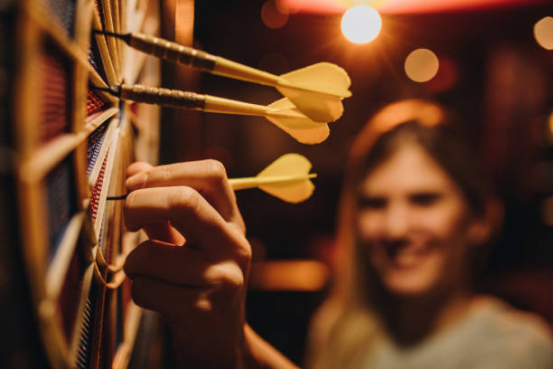
With the emergence of training awareness, the function of the dart board was redefined.
When the goal changes from “happiness” to “stability,” the way it’s used naturally changes as well.
Entertainment-oriented use emphasizes randomness:
Who throws first, how many rounds to throw, and whether to count the score can all be decided on the spot.
In a training mindset, the dart board is incorporated into a repetitive structure:
- Fixed throwing distance and height
- Set a specific hit area
- Record hit rate or deviation direction
In this process, the core of Dart board training transition is not changing the equipment but re-understanding the “meaning of the board’s existence.”
It is no longer the judge of victory or defeat but an amplifier of error.
Every deviation becomes a traceable signal.
Many experienced players mentioned in interviews that when they start adjusting the position of the dart board, the stability of the backboard, and the ambient noise, they are already assuming that this is a training scenario, not a casual game.
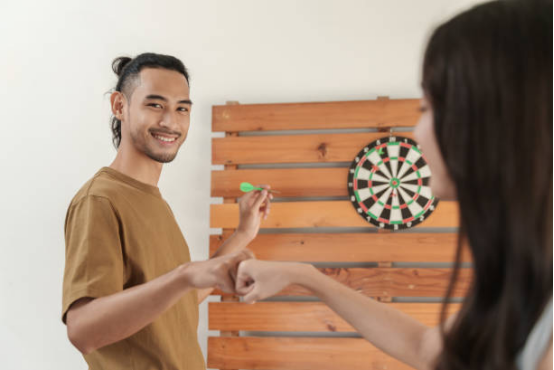
How changes in mindset affect usage habits, rather than simply upgrading equipment.
A common misconception is that “playing seriously” simply means “using more professional tools.” However, based on extensive user experience, the real change first occurs at the behavioral level.
For example:
- The pause before the shot becomes longer
- The target surface will be briefly observed after each round.
- Even when hitting consecutive shots, maintain rhythm rather than emotional fluctuations.
These changes have little to do with whether the dart board itself is high-end but are highly related to its ability to provide stable and consistent feedback.
In discussions about Dart’s practice mindset, one point is repeatedly mentioned:
The feeling of training comes from predictable feedback, not from stimulation.
Players develop trust when the dart board provides similar responses at different times and with varying intensity. This trust, in turn, strengthens their motivation to train.
The migration from social hubs to personal spaces: dart board
Another significant change is the “environmental role” of the dart board.
During the recreational phase, it’s often located in the living room, bar, or public space, serving as the focal point of interaction.
However, once the training phase begins, many players consciously move the board to a more private and controllable location.
- Stable light
- Less interference
- The same layout can be maintained for a long time.
This is not about escaping social interaction but rather about protecting one’s focus.
Behavioral science research indicates that when practice is conducted in a low-distraction environment, the brain is more likely to form stable motor memories.
Therefore, the change in the position of the dart board in space is an external manifestation of the change in mindset.
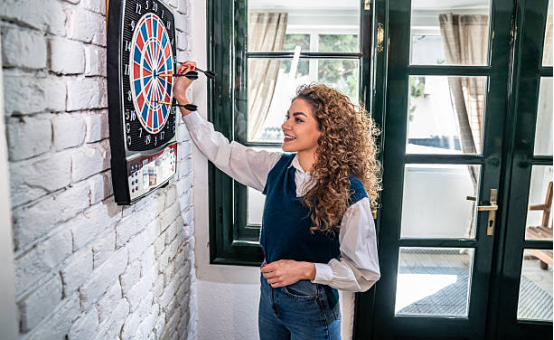
Once perceived quality is established, the player’s understanding of “practice” will change.
When dart boards are viewed as training equipment, players’ expectations of the practice itself will change.
They no longer pursue the “exhilaration” of each game but instead accept:
- Short-term hit rate fluctuations
- Stagnation or even regression at certain stages
- Establish long-term stability through repetition
This represents a mature psychological shift.
In many sports, the real training phase is often accompanied by a decline in enjoyment but an increase in confidence.
The dart board plays the role of a “silent sparring partner.” It neither encourages nor interrupts but simply presents the results as they are.
Further reading in related Dart board articles
Frequently Asked Questions (FAQ)
Q1: When can you tell if you’ve entered the training mindset?
When you start actively recording your hits and trying to explain why you missed, instead of simply attributing it to luck, you’ve usually crossed that line.
Q2: Are recreational dart boards unsuitable for training?
Not at all. The key isn’t the label but rather the consistency and stability of the feedback. Many players complete long-term practice on familiar boards.
Q3: Will the training phase diminish the enjoyment?
In the short term, it might, but in the long run, the sense of control that comes with stability often creates a deeper level of satisfaction.
Q4: Should I change the frequency of my practice sessions?
Instead of increasing the duration, focus on increasing the concentration during each practice session. Even for short periods, maintain a clear goal.
The concepts of “having fun” and “having fun seriously” are not contradictory.
The dart board’s role is essentially a change in the player’s self-perception.
As leisure gradually gives way to focus, the board has not lost its entertainment value but has been given new meaning.
Perhaps it can be understood this way:
during the entertainment phase, it makes time fly by;
During the training phase, it makes time become perceptible.
If one day you find yourself standing still, looking at the target for a few more seconds after your throw, that may be the moment when this transformation quietly takes place.