Landlord won’t let you drill? 3 “invisible” solutions for zero-damage Dart Board installation.

Holding your newly purchased professional-grade Dart board in your hand and looking at that pristine white apartment wall, are you caught in a dilemma?
On one hand, there’s the passion of being a darts enthusiast—you crave the therapeutic feeling of the metal dart tip piercing the sisal fibers; on the other hand, there’s the reality of being a tenant—the rental contract clearly states in black and white, “Drilling holes in the walls is strictly prohibited,” and violators will have their entire deposit forfeited.
For most renters, sacrificing thousands of dollars in deposit just to hang a dart board, or risking being harassed by the landlord with a magnifying glass when moving out, is clearly not worth it. But does renting mean you can’t have high-quality home entertainment?
Absolutely not.
As a seasoned dart board player who has “survived” various demanding apartment terms, I’ve developed a set of survival rules for dealing with the “zero damage” requirement. You don’t need to leave any permanent marks on the walls, and even when you move out, your landlord won’t know that this was once a professional apartment-friendly dart board setup.
Today, we’ll conduct an in-depth review of three installation methods that don’t require an electric drill to see which one allows you to enjoy the purest throwing fun while keeping your deposit.

Option 1: The Secret Behind the Door – Over-the-Door Hanger System
If you live in a very compact studio apartment, or if you don’t want to invest too much in hardware for this temporary accommodation, then an over-the-door dart board hanger is your best option.
This is not just a hook. It’s a clever physical system.
Principles and advantages
This system typically consists of two metal hooks (hung on top of the door) and a high-strength nylon adjustment strap. You attach the dart board to the strap’s special buckles and then easily align the bullseye to the standard 1.73-meter height by adjusting the strap’s length.
You’ll find that its biggest advantage is its rapid deployment . Friends come over? Hang it up. The landlord has a surprise inspection? Take it down and stuff it into the closet—the whole process takes only 30 seconds. Moreover, the door frame itself is a natural “protective shield,” so even if you miss, it will most likely stick to the wooden door (of course, the door also needs some protection), rather than that fragile plaster wall.
Fatal weaknesses and corrections
However, as a player who pursues the ultimate experience, I must point out its pain points: shaking and noise.
When you throw a dart at an object suspended from a strap, the kinetic energy cannot be fully absorbed, and the disc will “bounce” against the door and bounce back. This will not only produce a loud “thump” (your roommate will hate you), but it will also cause the disc to become unstable.
The Hack: Expert Correction Method
Don’t just hang straps. Buy some high-density foam strips or thick felt pads with adhesive backing. Attach them to the back of the dartboard around the perimeter. When you tighten the straps, the foam pads will be firmly “pressed” against the board. This preload can eliminate 90% of the shaking and 70% of the impact noise, turning a makeshift toy into a relatively professional training station.
Option Two: The Price of Freedom – Portable Stand
If your budget allows and you can free up about one square meter of space in the room, I strongly recommend that you skip all wall-mounted options and go straight for a stand-alone bracket.
This is currently recognized as the most perfect hanging dart board solution without drilling, bar none.
Why is it a favorite among professional players?
These stands typically employ a heavy-duty tripod structure similar to a photography light stand or speaker stand. They are completely independent of walls, door frames, or any building structure.
- Absolute freedom of distance: In cramped apartments, furniture is often piled up against the walls. With a stand, you can place the dart board in the center of the room for throwing and then put it away when you’re done.
- Perfect sound insulation: Since it doesn’t contact the wall, the path of sound transmission through solids is completely cut off. No matter how much you project it late at night, your neighbors won’t hear a single vibration.
- High precision: Most high-quality brackets come with a ruler and level, allowing you to adjust the height to the millimeter level without having to draw pencil marks all over the wall.
Realistic considerations
Of course, freedom comes at a price. First, there’s the price; a sturdy dartboard stand is often more expensive than the dartboard itself. Second, there’s the footprint ; although it can be folded, the base has a large span when unfolded.
If your room is so small that you can barely turn around, this might not be for you. But if you have a fairly spacious living room, it’s an investment you can make through countless moves and only need to buy once in your lifetime.
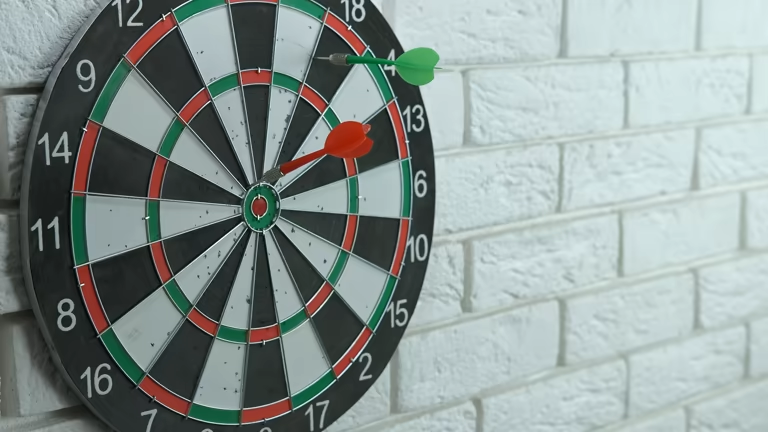
Option 3: A Double-Edged Sword – Heavy Duty Adhesives and Hook & Tape
This is also the first thing many renters think of when searching for hanging dart board without drilling : use 3M Command Strips or industrial-grade Velcro to stick the board directly to the wall.
Here, I must issue a very serious warning: please make sure you know what type of dartboard you are using.
For lightweight/soft dartboards (Soft Tip / Paper Board)
If your dartboard is an electronic disk or an entry-level paper disk weighing between 1 and 2 kilograms, industrial-grade Velcro is a good option.
Tip : Do not stick it directly onto wallpaper, as this will tear the wallpaper. It is best to stick it on a hard wall surface that has been painted with latex paint. Also, the area to be pasted should be large enough; it is recommended to use a crisscross pattern to cover more than 50% of the back of the wall.
For professional sisal boards—Red Alert
A standard 18-inch sisal dart board typically weighs around 5 kilograms. Combined with the impact of throwing, almost no non-marking adhesive strip can withstand this shearing force over a long period.
If you force the use of adhesive strips, there are usually two outcomes:
- A loud crash in the middle of the night, and the plate falls and breaks the floor (or your toes).
- When you checked out, you tried to peel off the adhesive strip and ended up tearing off a large piece of wall paint and plaster along with it. This cost much more than the compensation for drilling two small holes.
The only compromise solution using “glue”:
If you must use glue, please use the “wooden board intermediary method.”
Go to a building materials market and buy a piece of lightweight plywood larger than the dart board. First, use plenty of adhesive tape to stick the board to the wall (to distribute the stress), then install standard metal hangers on the board, and finally hang the heavy-duty sisal disc on the board.
The advantage of this is that the tension of the adhesive strip on the wall is dispersed, and you have a rigid medium for installing the mounting brackets. Even so, I still recommend checking the edges of the adhesive strip for peeling every few months.

Even if it’s a rented house, life is still your own.
A landlord’s ban should not be a reason for you to give up your hobbies.
Let’s review these three options:
- Over-the-door hanger: Suitable for users with very limited space, a limited budget, and who want quick storage solutions.
- Portable Stand: Suitable for hardcore gamers with ample budgets who seek a professional-grade experience and absolute sound insulation.
- Adhesives: Limited to lightweight dartboards or used cautiously as a last resort.
Before making a decision, please confirm the weight and type of your dart board . Don’t try to save a few dollars on installation accessories only to end up paying your landlord hundreds of dollars in wall repair costs later.
Now, choose a “stealth” option that suits you and hang up the disc. The moment the first dart lands squarely in the bullseye, you’ll find that this temporary dwelling finally feels a bit like “home.”
FAQ
1. Will using an over-the-door dart board hanger damage the door?
Without any cushioning, prolonged impacts can leave dents on the door panel surface, and metal hooks can wear down the paint on the top of the door frame. It is recommended to apply a thin layer of felt tape to the inside of the hook and add a sponge pad to the back of the hook to achieve truly “zero marks.”
2. In an apartment-friendly dartboard setup, how can you protect the walls from being damaged by darts that miss their target?
Since you can’t nail protective rings to the wall, you can consider buying these “puzzle-style” high-density foam protective pads (Dartboard Surround). They fit directly onto the outer ring of the dartboard and are secured by friction, requiring no additional nails or glue, and can effectively block 95% of off-target darts.
3. If I have to drill holes, what methods can I use to repair the wall without the landlord noticing?
If you must drill, use a finer drill bit. Before checking out, buy a tube of white wall filler or toothpaste (for emergencies) from a hardware store. Fill the small holes, smooth them with a scraper, and they’ll be almost invisible after drying. However, this trick won’t work for colored walls, so a no-drill solution remains the lowest-risk option.