
Table of Contents
You’ve just finished a long day at work, come home, picked up your dart board, and are ready to relax for half an hour in front of the dart board on the wall.
The first dart went too low. The second, in an attempt to correct, you instinctively raised your elbow, but it flew over 20 points. The third dart, you felt a strange resistance as you released it; the dart didn’t even land properly and bounced off.
Do you think this is just because you’re not feeling well? Or because you’re too tired?
Having witnessed countless so-called “genius players” eventually retire due to injuries, I want to tell you a cruel truth ignored by 99% of amateur players: your skills haven’t deteriorated; it’s your dart board mounting height that’s quietly destroying your muscle memory.
That mere 2-centimeter height error, or a slight shift in the ocche (outline), is forcing your body to compensate by twisting your joints. This isn’t just a matter of missing; it’s a fast track to the most feared nightmare in the world of darts—Dartitis (Ip/throwing disorder).
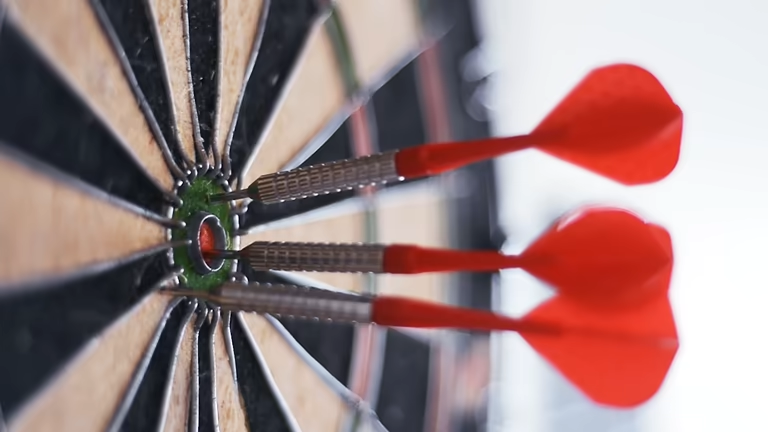
Microscopic collapse of muscle memory
In darts, we strive for “mechanical repetition.” A perfect throw is a perfect transmission of power from the ankle, knee, and waist to the shoulder, elbow, and wrist.
When your dartboard is suspended precisely at a bullseye height of 1.73 meters (5 feet 8 inches), your brain builds a trajectory calculation model based on this fixed coordinate. This is known as “muscle memory.”
But what happens if your plate hangs 3 centimeters too low?
Your brain is incredibly smart; it will immediately sense that the target has been lowered. But instead of telling you, “Hey, adjust the chart,” it subconsciously instructs you to lower your shoulders a little or delay the release point of your elbows by a few milliseconds.
This tiny compensation is deadly.
What should have been a stable structure supported by bones has become a tense posture forcibly maintained by small muscle groups. You’ll find yourself getting more and more tired as you play, and what used to be an easy arm swing becomes stiff. It’s like you’re used to wearing size 42 shoes and suddenly switch to size 41. You can still walk, but your gait will be distorted until your knees start to hurt.
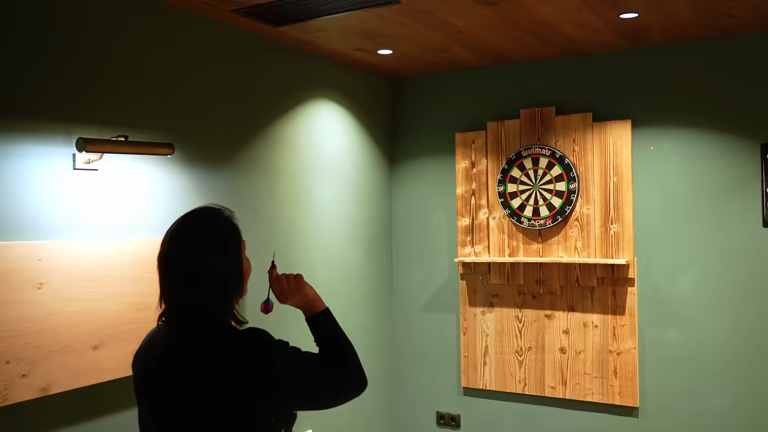
The body’s protests: From aches and pains to Elbow Pain From Darts
Many beginners, after practicing for a few weeks, will start searching for “elbow pain from darts”. The advice they often get is “take a break” or “wear an elbow brace”.
This is simply a quack doctor’s suggestion that only treats the symptoms and not the root cause.
While darts is not a high-intensity competitive sport, it is a very high-frequency repetitive strain injury (RSI) on one side. When the dart board is not at the correct height, the biggest victim is your elbow—the fulcrum of the throwing arm.
- Too high a dart: To send the dart up high, you must raise your upper arm excessively, leading to impingement syndrome. At the same time, to achieve a sufficient parabola, the wrist is forced to extend too far back, increasing stress on the tendons.
- Too low a throw: This is more common. Your body leans forward excessively, or during the “throwing” motion, you make a snapping motion at the moment of release to prevent the dart from hitting the ground. The shock force generated by this snapping motion is absorbed entirely by the tendons on the outside of your elbow.
This is a variation of the infamous “tennis elbow” (lateral epicondylitis) in the world of darts. If you feel a sharp pain on the outside of your elbow when you straighten your arm or turn a doorknob, grab a tape measure and check your wall immediately instead of buying painkillers.

The Psychological Abyss: The Hidden Causes of Dartitis
Now, we’re going to talk about a word that strikes fear into the hearts of all professional gamers: Dartitis.
It manifests as a sudden psychological shock: when you raise a dart to throw, your hand suddenly freezes. You can’t release your grip, or your muscles twitch uncontrollably at the moment of release. This is not just tension; it’s a break in the connection between the brain and the limbs.
You might ask: What does this have to do with the height of the Dart board?
The relationship is extremely important.
Dartitis often stems from subconscious insecurity and cognitive dissonance. When your installation height is not standard, the distance your eyes see and your body perceives is mismatched.
- Visual input: “The red heart is in this position.”
- Muscle feedback: “No, if I use the force I’m used to, the dart will go too high/too low.”
- Brain conflict: The brain attempts to correct this conflict within milliseconds, sending out chaotic neural signals.
- System crash: To prevent the “error” from happening, the brain directly cuts off the execution signal, and your hand is frozen in the air.
Once you develop these symptoms, you’ll find yourself desperately searching for curing dartitis exercises late at night. The internet will offer various suggestions about deep breathing, meditation, or changing your grip.
But few will tell you that the first step should be calibrating your hardware.
If you force yourself to practice in an ergonomically unfriendly environment, you’re not overcoming difficulties; you’re training your brain to fear throwing.
Reconstructing the foundation: Dart Board Ergonomics Stance
Since we want to elevate the dartboard from a mere “toy” to a vehicle that influences physical and mental health, we must discuss posture.
The standard height of 1.73 meters is the geometrically optimal solution based on average height, but everyone’s wingspan and throwing habits are different. This is why dart board ergonomics stance is so important.
A healthy and sustainable standing posture should follow the “principle of minimum tension“:
- Stable feet: Your center of gravity should be firmly planted on the ground like an anchor, not like a reed in the wind.
- Maintain a neutral spine: Don’t hunch over excessively to get a few centimeters closer. If you need to bend over to feel comfortable, it means there’s a problem with your Oche (throwing line) distance or disc height.
- Eyes level: In the setup position, your eyes, the dart, and the target should form a straight line. If you need to tilt your head back or down to “find” the target due to the height of the disc, the twisting of your cervical spine will compress nerves, thus affecting the fine motor skills of your hands.
Once you get all of this in order, you’ll find that throwing is no longer an “effort,” but a “flow.”
The real cure is “prevention”.
I’ve seen too many people only start to reflect on their movements after experiencing elbow pain from darts, or only begin to question life after showing signs of dartitis.
Please don’t wait until that time.
Take out your steel tape measure (not a stretch tailor’s ruler). Measure vertically from the center of the cone to the ground. It must be 1.73 meters (5 feet 8 inches). Even for that 1-centimeter error, it’s worth drilling a new hole and re-hanging the plate.
Also check your throwing distance: 2.37 meters (7 feet 9.25 inches). This isn’t just a rule; it’s a safe distance to protect your elbows.
In this world full of uncertainty, your dart board should be your strongest ally, not an invisible killer sabotaging your efforts. Respect the rules, respect the data, and most importantly, respect your body.
FAQ
1. Elbow pain from darts has already occurred. Should I stop practicing completely?
It is strongly recommended to stop. This is often a sign of soft tissue inflammation. Continuing to practice will only worsen the micro-tear. During the rest period, check if your dartboard height is forcing you to use incorrect “whiplash” motions. After recovery, try adjusting your stance to reduce the locking force on your elbows.
2. Does the thickness of the shoe sole affect throwing?
Yes, this is an often overlooked variable. If you play in boots at a bar and in slippers at home, there can be a 2-3 cm height difference. This is enough to change your visual angle. The professional advice is: when practicing at home, try to wear the shoes you would wear in a match, or fine-tune your dart board ergonomics stance according to the thickness of the sole.
3. Are there any curing dartitis exercises that are truly effective?
The most effective “practice” is actually “downgrading.” Switch to your other hand when throwing, or stand very close to the disc (e.g., 1 meter), and practice only the “release” motion, completely ignoring accuracy. This helps the brain rebuild neural pathways and eliminate the fear of “mistakes.” However, this must be based on the premise that your physical environment (disc height) is completely calibrated.