3 ways to completely eliminate the “impact noise” of your Dart Board

Table of Contents
It’s late at night, and you’re in top form. Every throw hits the bullseye perfectly, and each thud is the rhythm of your adrenaline surge.
“Tap…tap…tap.”
Suddenly, your phone lights up. Your downstairs neighbor has texted you: “Dude, are you banging on the wall? I have to go to work tomorrow. Can you please be quiet for a bit?”
At that moment, all the fun vanished instantly. If you live in an apartment or shared housing, this awkward scene has probably happened countless times. For us dart enthusiasts, the biggest enemy is often not a bad feel for the ball but that undeniable physical phenomenon: the noise of the dartboard hitting the board .
You might think closing the door will solve the problem, but reality is harsh. The sound of a dart hitting the disc isn’t just “auditory noise” transmitted through the air; more alarming is “structural noise” that travels through the walls.
That thud travels up the screws and through the joists, turning the entire wall into a giant speaker. To the neighbors or downstairs, it sounds like someone is hammering their ceiling.
Don’t rush to put your darts away. As a seasoned darts player, I’ve received countless complaints and tested countless solutions. Today, we won’t talk about honing your skills, but about survival—how to create a quiet dart board setup apartment that your neighbors won’t even notice through “acoustic decoupling . “
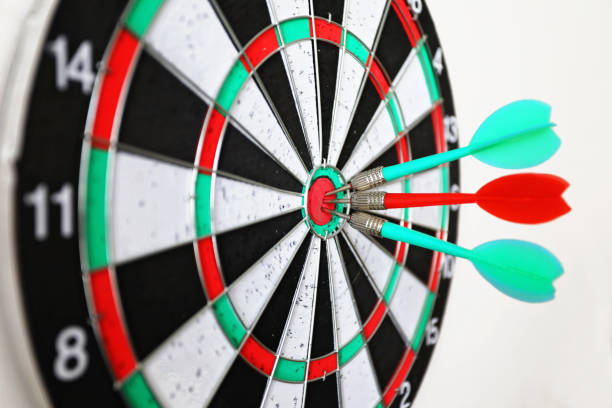
Core principle: Disconnect the “sound bridge”
Before you start, you must understand why your dartboard is noisy.
When you hang a dartboard directly on a nail or standard mounting plate on the wall, the board and the wall are “rigidly connected.” The kinetic energy carried by the dart impacts the board, and the vibration is transmitted directly to the wall through the mounting plate without obstruction.
The wall is rigid, and it faithfully amplifies these vibrations.
What we need to do is not to wrap the dart board in a blanket (that way you still can’t throw it in), but to cut off this “sound bridge”. We need to create a buffer layer between the disc and the wall, which is called acoustic decoupling.
First trick: The low-cost “Tennis Ball Hack”
If you’re on a tight budget or enjoy DIY projects, this is currently recognized as the most effective “poor man’s savior” solution. It might sound a bit comical, but the pressurized air inside the tennis ball and the outer rubber felt are excellent shock absorbers.
You need to prepare:
- 4 old tennis balls
- Strong double-sided tape or Velcro
- Plywood with a diameter similar to your dart board (as the middle layer).
Operating steps:
- Cutting the tennis balls: This is the most crucial step. Don’t just glue the balls on. You need to cut each tennis ball about 1/3 off, or even cut it in half, to form 4 hemispheres.
- To create the suspension layer: Don’t stick the tennis ball directly to the wall. First, stick the cut side of the tennis ball to the four corners of the plywood.
- Secondary installation: Secure the plywood (with the tennis ball side) against the wall. At this point, a “soft connection” supported by the tennis ball is formed between the plywood and the wall.
- Hanging the plate: Finally, hang your dart board on the front of the plywood.
Principle Analysis:
When a dart hits the board, the vibration is transmitted to the plywood and then to the tennis ball. The rubber structure of the tennis ball undergoes a slight deformation, converting kinetic energy into heat instead of directly impacting the wall.
This eliminates approximately 60-70% of the low-frequency impact noise. For most players seeking a quiet dart board setup apartment , this setup is sufficient to let you throw to your heart’s content at midnight.
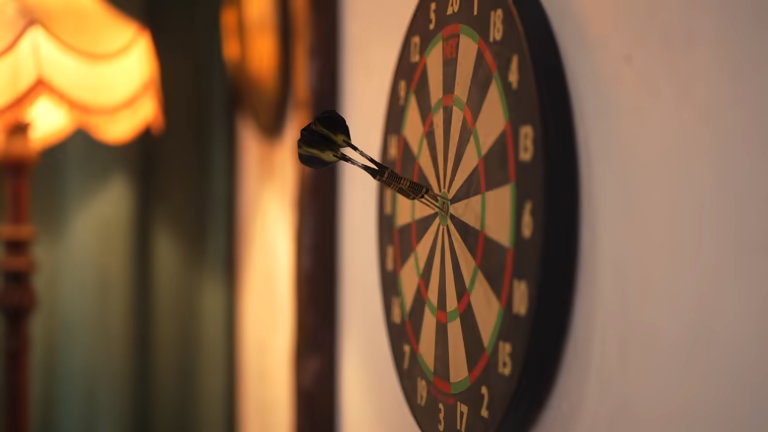
The second method: Reconstruct the backboard material.
Many enthusiasts buy ready-made wainscoting or dartboards, thinking this will provide sound insulation. This is a misconception.
Most dartboards on the market are made of rigid polyurethane or wood, and their primary function is to protect walls from punctures, not to insulate sound.
To truly achieve a soundproof dart board backboard , you need to pay attention to the material’s “density” and “porosity”.
Avoid using:
- solid wood boards
- hard plastic boards
- thin sheet metal
These materials have extremely high density and will perfectly transmit vibrations.
Recommended solution: a “sandwich” structure of cork and high-density sound-absorbing cotton.
- Go to the building materials market and buy a cork sheet that is at least 20mm thick.
- Buy another piece of high-density acoustic foam of the same size, specifically designed for recording studios.
- Attach the sound-absorbing foam to the wall, attach the cork board to the foam, and finally install the dart board in the center of the cork board.
In this structure, cork provides sufficient support (preventing the disc from wobbling), while the sound-absorbing foam behind it acts as a shock-absorbing spring.
This alternating “soft-hard-soft” structure greatly attenuates sound wave energy. You’ll find that the sound of the dart hitting the disc changes from a sharp “thud” to a muffled and faint “plop.”
The third tip: Use a professional-grade Vokul or similar sound-absorbing stand.
If you don’t want your walls to look like an unfinished carpentry site, or if you have extremely high aesthetic requirements, then purchasing a professional sound damping system is the only solution.
There are some products on the market specifically designed to reduce dart board noise for neighbors , such as Winmau’s Wispa system or Vokul’s similar stand (although the brands are different, the principles are similar).
How do they work?
- These systems typically abandon the traditional “center screw suspension method.”
- They use a large outer-circle disc fixed to the wall, while the dart board itself is “suspended” in the center of the disc by a series of strong springs or rubber cantilever arms.
- The dartboard doesn’t actually touch the wall directly; instead, it “floats” in the air like a car’s suspension.
Advantages
This is currently the most thorough physical decoupling solution. According to actual measurements, it can reduce through-wall noise by up to 90%.
For wooden-structured apartments with extremely poor wall sound insulation, this is the ultimate weapon against being evicted by the landlord.
Disadvantages
It’s expensive, usually more expensive than your dartboard . The installation process is also more complicated, requiring you to drill more holes in the wall to secure the external bracket.
But the investment is usually worthwhile in terms of maintaining good neighborly relations and moving.
Details determine success or failure: door gaps and tightness
After completing the above major projects, don’t overlook two small details, as they are often the reason why all your efforts will be in vain.
First, check if your dartboard is loose . A lot of noise actually comes from tiny gaps between the board and the clips. With each impact, the board “bounces” on the clips, creating secondary noise.
Stuff a small piece of folded paper or cardboard into the back of the board to ensure it stays firmly in place; this simple action can reduce noise by 20%.
Second, pay attention to door gaps . Although we are mainly addressing structural noise, airborne sounds (like the crisp sound of a dart hitting the plate) can still escape through door gaps.
Buy an inexpensive door draft stopper; it not only prevents drafts but also traps high-frequency sounds inside the room.
Be a high-quality “invisible” player
Darts is an elegant sport, and your neighbor shouldn’t be the one to bear the cost of your practice.
After implementing any of the above methods, you will discover an unexpected benefit: when the Dart board…
When the thud no longer echoes throughout the room, you can hear the pure scraping sound of the dart entering the disc more clearly.
This not only soothes the neighbors’ nerves but also enhances your immersion.
Now, go cut those tennis balls in half, or order that professional suspension system. Don’t let noise become a stumbling block on your path to 180 points.
FAQ
1. Are electronic dartboards (soft tip) quieter than hard dartboards (steel tip)?
Quite the opposite. This is a huge misconception. Electronic dartboards are usually made of plastic, and darts hitting a plastic panel produce a loud “thud.”
This high-frequency noise is extremely penetrating, and the plastic casing itself creates a resonant cavity effect. If you want to keep your apartment quiet, a traditional sisal board combined with the soundproofing solutions mentioned above is the only option.
a soundproofing dart board backboard directly from cardboard ?
The effect is very limited. While corrugated cardboard offers some cushioning, its low density makes it ineffective at blocking kinetic energy transfer.
Furthermore, cardboard quickly compacts after repeated stress, losing its shock-absorbing capacity. In contrast, high-density cork or rubber pads are more durable and professional solutions for reducing dart board noise for neighbors .
3. Will using a silencer affect the stability of the dart board ?
Improper installation will cause this. This is the biggest risk factor in DIY setups (like the tennis method).
If the disc wobbles, your aiming reference will shift. Therefore, when setting up a quiet dart board apartment , always ensure the “soft connections” have sufficient support.
Professional silencing brackets are usually calibrated to ensure the disc absorbs vibrations and instantly stabilizes, preventing aftershocks.