
Many people make a fatal mistake when running a bar or lounge: they are overly obsessed with expensive decorating styles while neglecting the core element that truly keeps customers “pinned” to their seats—interactivity.
It’s like spending a lot of money to buy a sports car but not filling it with gas.
If your current customer traffic is only packed on Fridays and Saturdays, while Tuesdays and Wednesdays are as deserted as a library, then what you really need isn’t more expensive craft beer, but an unassuming dart board.
Don’t rush to argue; this is more than just a wall decoration. In my ten years of experience in DTC brand marketing and offline commercial space renovation, I’ve seen countless community pubs on the verge of bankruptcy achieve a surge in beverage sales within a single quarter simply by introducing a professional dart board operation system.
Today we’re not talking about sentimentality; we’re talking about money—how to leverage a dartboard to boost your revenue.
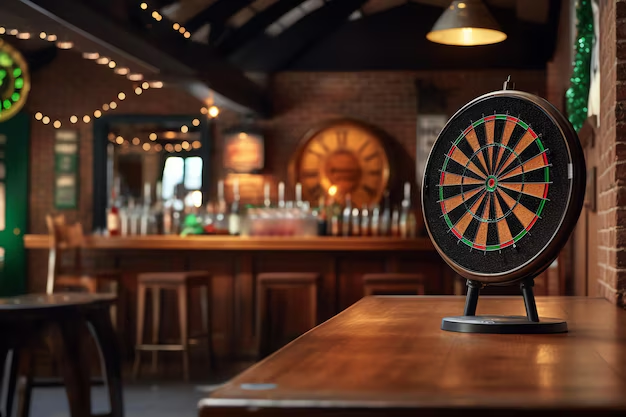
The “stay time” here is more valuable than you think.
Let’s start by dispelling a misconception: customers come to bars not just to drink, but to “kill time.”
Your job is to make that time-killing process fun, so fun that they forget to look at their watches.
Imagine this scenario: A few friends are sitting in a booth; a couple of drinks later, the conversation has run its course, and an awkward silence begins to fall.
What usually happens at this point? Someone will pull out their phone, and then ten minutes later, they’ll pay the bill and leave.
But what if there was an electronic target gleaming in the corner or a traditional hard target emitting the aroma of sisal?
“Hey, the loser buys the next round.”
This is the kind of heavenly sound that bar owners love to hear most.
dart board In your space, you’ll find that guests’ behavior patterns change physically. It’s not just a game; it’s a social lubricant.
Dopamine is released when a 22 g tungsten dart leaves your fingertip, arcs through the air, and sinks into the sisal fibers with that dull, satisfying “thud.”
These subtle sensory stimuli—the tactile sensation of knurled metal rubbing against fingerprints, the vibration of a dart hitting a target—can greatly prolong a guest’s period of excitement.
In this pub darts revenue model, the core formula is very simple: game time = dwell time = more spending.
According to a long-established UK survey of traditional pubs, customers who participate in darts games consume an average of 35% more drinks per visit than those who simply chat.
Why? Because darts is one of the few sports that can be played with one hand without interfering with holding a drink in the other. The intervals between rounds provide perfect opportunities for a toast.
Build your ROI model: not just break even, but make huge profits.
As business operators, we must do the math. Many business owners hesitate because they feel that the investment of several thousand or even tens of thousands of dollars for a commercial electronic dart machine is too high.
But there’s a detail that most people overlook: the hidden rate of return.
Let’s build a simple Darts ROI for the bar computation model.
Assuming you purchase a mid-to-high-end commercial dart board system (including crash barriers, scoring systems, or electronic rigs), the initial investment would be approximately $3,000 (and even less for a traditional hard target configuration, possibly as low as $500).
Explicit income (if it’s a coin-operated machine):
If the price is set at $1 per game, and you play 20 games every night, the monthly income from in-game currency alone would be $600.
It seems like it would take 5 months to break even?
Wrong. Utterly wrong.
Hidden revenue streams (alcohol premium):
The real dartboard business case lies in the drinks.
If you organize a small Wednesday darts league and attract 4 teams of 4 players each, it means you’ve gained 16 new regular customers on what was originally considered a “dead day.”
If each of these 16 people drinks two extra beers each night (each beer yields a profit of $5), that’s an extra $160 in net profit.
There are 4 Wednesdays in a month; that’s $640.
That’s not all. These 16 people usually don’t just drink; they’ll order fries and chicken wings. Coupled with the high emotional value brought by the game, their impulse to spend is twice as high as usual.
Combining explicit and implicit revenue, the actual payback period for an expensive piece of equipment often only takes 6 to 8 weeks.
After that, the machine becomes a tireless money-printing machine with almost no maintenance costs (except for occasional replacement of the dart head or target).
Industry insider secrets revealed:
Many savvy bar owners even set their electronic dart machines to “Free Play.” Why? Because they’ve calculated it perfectly: earning a few coins is far less profitable than getting customers to order a tower of beer because “darts are free here.” This is a classic strategy of using a low-cost traffic source (free game) to replace high-margin products (drinks).
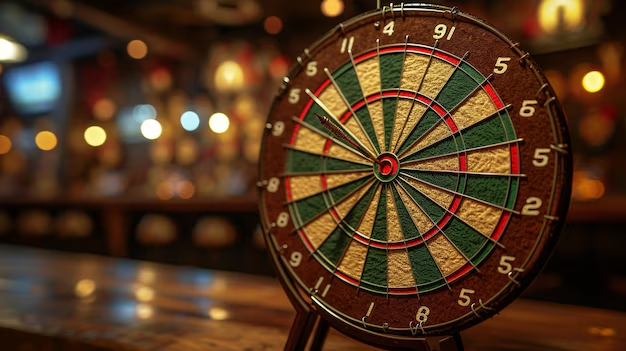
Operational strategy: Don’t just buy the equipment and then ignore it.
Hardware is just the foundation; how you operate it is the key to creating a significant difference.
If you simply hang your dart board on the wall and expect it to attract customers on its own, you’ll likely be disappointed. You need to build an “ecosystem” around it.
You need to pay attention to the layout. Never put the darts area in the main aisle; nobody wants to worry about hitting a waiter while throwing a dart.
It needs a relatively independent, yet visible “stage area.”
Clear throwing lines (oche) must be marked on the floor, not just for the rules, but also for the sense of occasion. When a guest stands behind that line, they enter “competitive mode.”
Next comes equipment maintenance. I’ve seen far too many bars where darts have broken tips that no one replaces, and targets are smashed and don’t spin. These kinds of details can severely damage the experience.
As a savvy business owner, you must ensure that the communal darts you provide have some weight (at least 16 g of brass darts, not flimsy plastic toys), which gives beginners a great deal of “feel confidence.”
Strategies for different stages:
- Short-term (1-2 months): Host a “Newbie Night” where everyone who participates in the games gets a free shot. The goal is to break the ice and let guests know that you have this new service.
- Mid-term (3-6 months): Introduce a leaderboard. Anyone who breaks the store’s highest score record gets their photo displayed on the wall and receives a 20% discount on their entire purchase. This stimulates men’s primal competitive spirit.
- Long-term (6 months+): Establish or join a regional league. Make your bar your “home turf.” Once this sense of belonging is established, competitors won’t be able to steal your core customer base, no matter how much they lower their prices.
FAQ (Frequently Asked Questions)
1. Which type of dart board is more suitable for a bar environment?
This depends on your target customer base and noise tolerance. Traditional hard dart boards (bristle boards) are suitable for quiet, stylish British pubs, offering minimal noise and a premium feel when used with steel needle darts.
Electronic soft-tip boards, on the other hand, are better suited for noisy sports bars or nightclubs because they come with a scoring system and sound and light effects and are safer, significantly reducing the risk of intoxicated patrons accidentally injuring others.
From a darts ROI for a bar perspective, while electronic tip boards are initially more expensive, their beginner-friendly nature encourages more spending.
2. How much space is needed to install a dart board in a bar?
This is a very practical dart board business case. The standard international throwing distance is 2.37 meters (hard target) or 2.44 meters (soft target).
Including the thrower’s standing space and safety buffer zone, you’ll need a long, narrow area at least 3 meters long and 1.5 meters wide. If you want to profit from hosting competitions, it’s advisable to allocate more space for spectators, as beverage consumption by the audience is a major source of revenue.
3. How to calculate the maintenance cost of a Dart board?
Maintenance costs are extremely low, which is why it’s a high-return project. For hard targets, the main maintenance involves replacing the target plate every six months (approximately $50-$80) and regularly replenishing the common darts to prevent wear and tear.
For electronic targets, the main maintenance involves replacing broken plastic dart heads (costs are negligible) and occasional sensor repairs. Compared to the frequent replacement of the netting on a pool table, the maintenance of dart equipment is incredibly low.
4. What are the most common operational mistakes that novice business owners make?
The biggest mistake is buying a low-quality dart board. A toy dart board costing a few hundred dollars will break down in a week under frequent commercial use, and it will severely affect your feel (e.g., frequent dart drops).
A poor experience will make customers think your store is “cheap.” Remember, in this field, professionalism is directly equivalent to authority and the ability to command a premium.
Conclusion
The essence of the bar business is a battle for attention.
In this era where everyone is glued to their phones scrolling through short videos, things that can make a group of people lift their heads, stand up, and cheer or lament for a common goal are becoming increasingly rare. A professional Dart board is that powerful tool that can tear through digital indifference and rebuild real physical connections.
Are you still worried about whether it will break even? Or you should ask yourself:
Why are my competitors already using it to steal my customers?
Stop hesitating! Go measure your wall now and give your business a shot in the arm. The moment the first dart lands squarely on the bullseye, you’ll hear the sound of coins falling into your pocket.