Dart Board training program: a three-stage progression from beginner to expert.

entertainment but In the training room, it was so quiet that even the air seemed to freeze. Only the sound of a thunk pierced the space—the crisp sound of a dart striking the board was like a confirmation. Many people don’t realize that a systematic dart board training plan is not just a game or entertainment but a skill development method that can be quantified, designed, and even broken down into stages.
-to-pro Moreover, its barrier to entry is surprisingly low: a dart board, a set of darts, and a stable stance are all you need to complete a beginner-to-pro dart guide.
If you’ve always been interested in darts but haven’t quite figured out how to move from casual throwing to a more professional pace, then this article might just provide you with a clear, step-by-step, yet engaging roadmap.
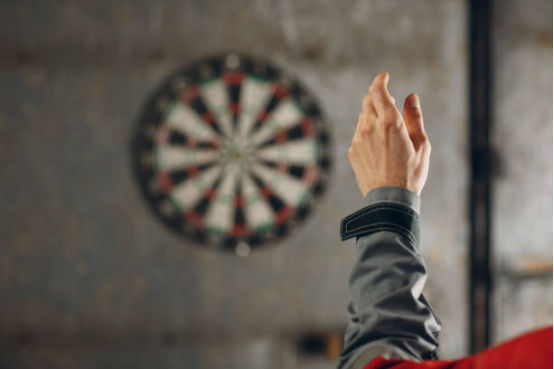
into Phase 1: Basic strategies for beginners to transform the “unpredictable” feel into a “stable” feel.
Beginners’ training logic is often misunderstood. Many people start by focusing on the T20 area and trying desperately, but in the first 30 minutes of throwing, what you should really be practicing is “rhythm,” not the throwing points.
The core objective of this phase is singular:
to make the relationship between Dart and Board predictable.
The sound, the angle, and the way the wrist is released—these details can all be traced.
1. Fixed stance and shooting trajectory.
Professional athletes often say, “Consistency is more important than power.” This is especially true for beginners. You need to establish your own “movement template” at this stage, rather than blindly imitating the posture of experts.
Suggested practice method:
- Choose an angle where you can stand naturally and steadily.
- Slightly shift your weight onto your front foot.
- Grouped in 20-minute intervals, focusing solely on whether the shooting trajectories are consistent.
This isn’t a shortcut to rapid progress, but it will make your subsequent improvements much smoother.
power; 2. Control your power, don’t just “throw it.”
Many beginners often use too much or too little force when they first start using dart boards. Too much force will cause the dart to swing excessively, while too little force will result in the dart not penetrating the target.
force. But what you need to know is that professional dart throwers don’t rely on brute force, but rather on a “clean release point.”
Training can be more lifestyle-oriented—dim the lights in your training area to naturally focus your attention on the feel of the darts, avoiding excessive visual distraction.
3. The target area doesn’t need to be complex; the simpler, the faster you’ll get into the flow.
Beginners don’t need to rush into advanced dart practice.
Practice goals only need to be clear and simple; for example:
- Targeting the same large block 20 times in a row
- No points are counted; only the clustering of landing points is considered.
When your darts can form “clusters” within a reasonable range, it means that your feel has shifted from chaos to stability.
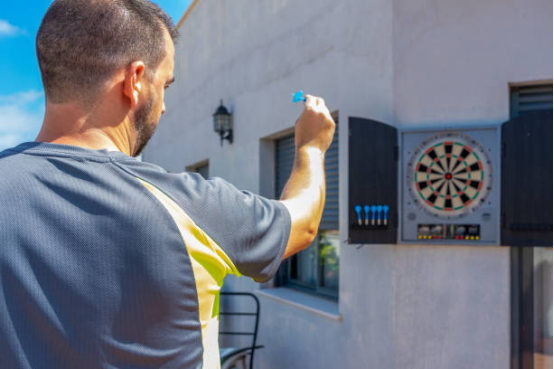
Phase Two: Intermediate Practice, Strengthening “Aiming Skills” into a Repeatable Ability
Users at this stage typically have a certain level of skill, but their progress begins to slow down. You’ll find that
you can achieve accuracy, but it’s difficult to maintain;
You can hit the target once or twice in a row, but after a while, you’ll go astray again.
This isn’t a regression but rather a sign that you’ve reached a “bottleneck” in your training plan.
At this stage, you need to transform your dart board practice from a “feeling” exercise into a “structured exercise.”
1. Zoned training to build your “confidence zone.”
Professional darts players all have their own comfort zone. Some are good at 19, some are good at bull, and what intermediate players should do most is to find their own “stable zone.”
The method is straightforward:
Break down the four quadrants of the dart board into blocks, and consistently hit one quadrant in each practice session.
Calculate the hit rate.
Select the area with the highest hit rate as your “confidence zone.”
This can be a safe spot for you during a game or competition.
2. Rhythm Training: Three darts form a sequence of movements.
Beginners often treat each dart as an independent movement, but intermediate players need to train “coherence.”
Try this set of exercises:
- First dart: Finding the feel
- Second dart: Confirm path
- Third Dart: Execute a Precision Throw
This kind of rhythm training is common in the daily routine of professional athletes. It can improve the efficiency of your movements and reduce the situation where “a bad first dart leads to chaos in the rest of the game.”
3. Incorporate mild stress testing.
If you always practice alone and completely relaxed, you’re more likely to become distracted when precision is truly needed.
You can try incorporating:
- Complete the fixed target within 5 minutes.
- Blocks can only be changed after a certain area is hit.
- Set up “small punishments” to simulate psychological stress.
This allows the dart board training plan to more closely resemble real performance, rather than being effective only in a relaxed state.

Phase Three: Advanced Training, Transforming Skill from “Sometimes Accurate” to “Always Under Control”
In the advanced practice stage, your goal is no longer just “learning to throw,” but mastering the controllability of the Dart Board. Players at this stage typically pursue:
- Stable hit on the triple region
- Proficiency in tactical switching
- The ability to maintain stable output during long practice sessions
You may have seen professional athletes consistently hit T20 under pressure. This is not just talent but the result of “automatic movement” accumulated from high-intensity Dart Board training.
- Fine-tune every detail to make the movements “unconsciously precise.”
Advanced Dart Board players enter a state where they no longer need to consciously think about their movements; their bodies automatically make the optimal choices.
To reach this level, you can try:
- Recording your own throwing process
- Analyzing whether the elbow is deviated
- Checking if the release points are consistent
This kind of training is more important than you might think, because the difference between winning and losing at high levels often comes from a 1° angle deviation on the Dart Board.
- Train strategy switching to enhance your tactical capabilities.
Advanced Dart Board practice is not just about aiming but also about “strategic control.” You need to learn:
- When T20 is unstable, switch to zone 19.
- How to plan an achievable path when it’s time to wrap up the game.
- How to avoid “life-or-death” aiming.
True masters never bet blindly; they find the right place for each dart on the Dart Board.
- Simulate long-duration matches to train fatigue resistance.
Professional Dart Board players often compete in matches that last 1-2 hours or more. Even slight fatigue in the arm can cause a drop in accuracy.
Training methods:
- Practice continuously for 40 minutes without stopping
- Record the hit rate changes every 5 minutes
- Identify your fatigue points and improve your movements
When you can remain stable even while fatigued, you’ve made the core leap from “enthusiast” to “advanced player” in Dart Board training.
Three-stage integration: Making Dart Board a true “skill path” for you.
When you connect all the stages, you’ll find that this beginner-to-pro dart guide isn’t high-pressure training but rather a natural progression path from easy to professional.
A good dart board training plan should not be boring but rather like a gradually accelerating soundtrack, accompanying you from stabilizing your feel to mastering your area and then to strategic advanced practice.
The dart that lands most securely often comes from the previous, unremarkable practice day.
The charm of darts training lies in the fact that it won’t reject you because of your mood or the weather.
It can quietly accompany you, and it can also provide feedback when you are in top form.
It can help you unconsciously refine your movements from chaotic to precise and from random to stable.
A true master isn’t made in a day but rather is someone who, after countless deviations from their goal, can still pick up the next dart and continue practicing.
If you’re ready to make your dart board training more systematic, why not start with “30 minutes today”?
So, where will your next dart land?