Determine whether the training method should be adjusted based on the Dart board status.

When was the last time you took a close look at your dart board?
I’m not referring to how many points you get, but rather putting your face close to the target and observing the “scars” left by thousands of impacts.
Most people make a classic mistake: treating the dart board merely as a passive object receiving force, a consumable for recording scores.
After each training session, they throw the darts, turn off the lights, and leave.
If you’re doing this, you’re missing out on the most honest and free personal trainer in the world.
In the thousands of cases I’ve handled, I only need to glance at a client’s target plate that they’ve used for three months to pinpoint the problem with their throwing posture, and I can even guess whether they recently injured their shoulder.
Because Dart board doesn’t lie.
Every worn area, every overused quadrant, even the bounce marks left on the metal mesh edges—all are physical imprints of your muscle memory.
Today, we won’t talk about how to get a high score; instead, we’ll conduct a “forensic examination” to see how your target disc, through its dire condition, suggests that you should completely change your training methods.
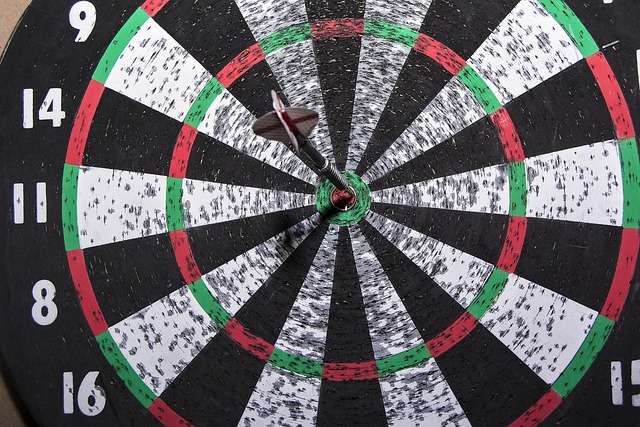
Longitudinal wear vs. lateral spread: Your elbows are “talking.”
Place your dart board in natural light, preferably with the light from the side.
If your 20 zones (especially the Triple 20 zone) show a clear longitudinal strip of wear—that is, dense pinholes forming a vertical line that extends even up and down to the 5 and 1 zones.
Congratulations, your elbow is very stable.
This usually means your arm stroke is perpendicular to the ground, which is excellent.
However, this dart board condition analysis also reveals a harsh truth: your release point is extremely inconsistent.
You might release too early this time (the dart flies high) and too late the next time (it flies low).
At this point, what you need is not to keep relentlessly hitting the bullseye, but to stop, practice “blind throws,” and feel the microsecond difference in the instant your fingertips leave the dartbox.
Conversely, if your wear is spreading laterally, like a scattered cloud.
That would be a big problem.
It means your elbow is wobbling from side to side during the throw, or your center of gravity is shifting.
Increasing training volume at this point will only reinforce incorrect posture.
What you need to do is immediately reduce the throwing distance, or even sit down to throw, forcing your upper body to lock and using only your forearm to generate power.

A “drooping” angle of entry: It’s not just a matter of dart weight.
When you throw darts, have you ever paid attention to your posture?
Examine the shape of the holes left on your dart board.
A normal hole should be a dot.
However, if you find that the holes are “teardrop-shaped,” or if there are obvious downward tears in the sisal fibers underneath, it means that your dart struck the target with a “nose-down” posture.
This is an extremely dangerous Dart training adjustment sign.
Many beginners think, “As long as it stays in place, it’s fine.”
That’s completely wrong.
When the tail of a dart droops, it actually takes up the space below it.
This means that if you try to throw a second dart below the first, it will most likely be deflected.
This isn’t just a problem with equipment settings (like a dart shaft that’s too long or a tail that’s too heavy); more often than not, it’s due to insufficient wrist power.
At the moment of release, you don’t give the dart enough “push” or “spin,” causing its kinetic energy to diminish at the end of its flight, resulting in premature descent.
An industry insider revealed: Many dart manufacturers recommend beginners buy heavy tungsten carbide darts, arguing that they are “more stable.” The real business logic is that heavier darts more easily mask weaknesses in power, giving you the illusion of improved skill and reducing returns. However, using heavy darts to mask wrist weakness in the long run will limit your skill ceiling.
If your dart board is covered in these kinds of tears, immediately reduce the weight of your darts or strengthen your wrist “whip” technique.
20-Zone Baldness Syndrome: You’ve Fallen into the Comfort Zone Trap
This is the most typical “amateur expert” target plate I’ve ever seen:
The Triple 20 area has been punctured to a pulp like a haystack, even exposing the base plate inside, but the adjacent 19, 18, and 17 areas are as new as if they just came from the factory.
You might see this as a sign of your accuracy.
But in my opinion, it’s a sign of a morbid training imbalance.
This state of mind on the dart board is screaming at you: you are avoiding difficulties.
In real games, especially in the checkout phase of a 501 game, you can’t always shoot only 20 points.
When your opponent forces you to shoot Double 16 or Triple 19 to win, your brand-new, never-before-seen 19-point area will feel extremely unfamiliar.
A true master’s target plate shows uniform wear across its entire surface.
If your target pad shows these “localized bald spots,” immediately stop simply training for scores.
You need to introduce mandatory “round the clock” training or specifically target those “new areas” with destructive exercises.
Here’s a detail that most people overlook: your muscle memory is only complete when you get used to the visual differences at every angle of the target disc.
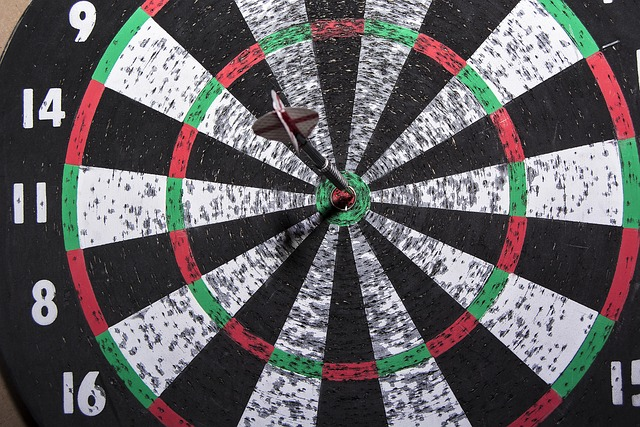
Changes in sound: Desensitization of auditory feedback
Finally, use your ears to check.
A newly purchased high-quality sisal target plate makes a dull, short “thud” sound when a dart hits it.
However, as it is used, if the sound in a certain area becomes a hollow “plop” or a metallic “clang,” it indicates that the internal sisal structure has collapsed.
This leads to a very subtle logic: training in a bad area will ruin your feel for the game.
When a dart strikes a loose area, it encounters less resistance and penetrates deeper into the target.
Your brain then mistakenly interprets this as, “Oh, this is just the right amount of force.”
But when you switch to the competition venue and face a new, tight target, the same force may not penetrate deeply enough or may even cause it to bounce off.
Don’t try to squeeze every last drop of value out of a dart board.
When its sound feedback is no longer crisp, or the fibers can no longer grip the darts, it has already lost its purpose as training equipment.
Continuing to use it at this point is just training your brain to adapt to “incorrect feedback.”
FAQ (Frequently Asked Questions)
Q1: Is the increase in bounce-outs due to my declining skills, or is it time to replace the dart board?
A: This depends on the situation. Check the metal mesh (spider).
If the darts bounce off due to deformation or warping of the metal mesh, then it’s a problem with the dartboard, and you should replace it immediately.
However, if the darts frequently bounce off in areas without the metal mesh, and the dartboard condition analysis shows that the fibers are still tight, then it’s usually because your angle of entry is too shallow, or your dart tips are too blunt (or have barbs).
If it’s the latter, please sharpen the dart tips with a whetstone; barbs will damage the dartboard.
Q2: Can rotating the board solve training imbalance?
A: It can extend the lifespan of the target disc, but it can’t mask training problems.
If you rotate the target disc, moving the original 20 sections to the 12 sections, and find that two weeks later the 12 sections (now at the top) are worn out, while the rest are still new, this confirms your problem: you can only throw at the top, not the bottom.
In this case, rotating the target disc actually helps you confirm that it’s a problem with the “person,” not the “disc.”
Q3: How do I determine the wear and tear on a soft-tip dart machine?
A: Electronic dartboards don’t have the physical wear and tear of sisal, but you can check the dart breakage rate.
If you notice a significant increase in plastic darts breaking into the eye recently, or frequent machine misjudgments, this is usually a dart training adjustment sign: your throws are too forceful, or the trajectory has become stiff and straight (hard hit).
Electronic darts emphasize a more curved and gentle trajectory; increased dart breakage is a sign of stiffness in your technique.
Q4: What causes a bulge in the center of the target surface?
A: This is usually because the humidity in your training environment is too high, or you tried to wash the dart board with water (never do this!).
Sisal absorbs water and expands, pushing up the metal mesh.
In this state, the target board density is extremely uneven, which will severely interfere with your training feedback; it’s recommended to discard it immediately.
Conclusion
a dart board is essentially a countdown to the quality of your training.
Don’t wait until it’s completely ruined before you start analyzing it.
Starting today, every time you pull a dart, take an extra 5 seconds to look at it.
- Observe the shape of the hole.
- listen to the texture of the sound.
- and feel the surface texture.
Those seemingly chaotic needle holes are actually a sophisticated radar chart. It relentlessly records every instance of laziness, hesitation, and impatience you exhibit.
When you learn to read your target, you learn how to be your own coach.
If you find an area sending out “SOS signals,” stop, adjust your breathing, and change your posture.
After all, we don’t just want to smash it; we want to smash it perfectly.
Remember, the dart board is innocent; it simply reflects your appearance faithfully.