
Precise dart board throwing is not just the result of hand-eye coordination but a complete chain of motion: from the shoulder joint initiation to the finger release, each step determines the trajectory and landing point of the dart. Only by deeply understanding the details of the dart-throwing motion can players truly master the secrets of precise throwing and achieve the goal of precision release darts.
Shoulder joint initiation and stability
The core power of the throwing motion originates from the shoulder joint. A stable and flexible shoulder joint provides continuous and controllable force, allowing the dart to travel along the ideal trajectory. Studies show that even small changes in the shoulder’s rotation angle can significantly affect the dart’s impact area. Therefore, keeping the shoulder joint relaxed before throwing, while slightly guiding it towards the target, is crucial for ensuring the continuity of the movement.
In practice, players should use a slight shoulder rotation to drive the upper arm, smoothly transferring the power to the elbow joint. This not only reduces shoulder muscle tension but also increases the repetitiveness of the throwing motion, making each throw against the dart board more precise.

Elbow Angle and Power Transfer
The angle of the elbow is a key factor in controlling the speed and angle of the dart. It is generally recommended to maintain an angle of about 90 degrees during the throwing preparation phase, which helps to conserve power while preventing excessive arm stiffness. By adjusting the angle, players can fine-tune the trajectory of the dart to bring it closer to the intended impact point.
Through repeated training, experienced players have discovered that subtle adjustments at the elbow have a greater impact on throwing accuracy than intuitive wrist movements. Combined with the power output from the shoulder joint, the elbow angle forms the middle link in the dart motion chain, smoothly transferring power to the forearm and wrist.
Micro-movements released by the wrist
The wrist release action acts as a “fine-tuner” in the dart board throwing chain. A correct wrist release can adjust the dart’s trajectory, achieving a higher hit rate on the dart board. Research shows that the angle and force of the wrist release directly affect precision release darts: slight back-and-forth swings can change the dart’s arc, while the direction of rotation determines its stability on the dart board.
For beginners, mastering the rhythm of wrist release is crucial for consistent dart board performance. It is recommended to fix the sequence of shoulder, elbow, and wrist movements through slow-motion training and mirror observation, gradually building muscle memory and making the dart board throwing motion natural and fluid.

Fingertip dart release and final accuracy
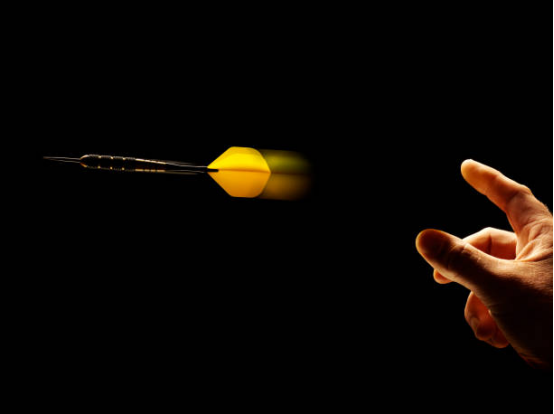
The final moment the dart leaves the finger is the most delicate link in the entire motion chain. The angle, force, and feel of the fingertip leaving the dart directly determine the dart’s flight stability. Releasing too early may cause the dart to fly too low, while releasing too late may cause it to rise or deflect. Precisely controlling the timing of the release is the final step in achieving accuracy in dart-throwing motion.
Some advanced players specifically use darts of varying weights during training to understand how fingertip pressure affects the trajectory of the darts. This method not only improves the refinement of movements but also enhances adaptability to different dartboard types.
Systematic training and motor coherence
To truly improve throwing accuracy, training a single movement is insufficient to cover the entire chain. Complete training should include shoulder stability exercises, elbow angle adjustments, wrist release simulation, and fingertip-to-dart awareness exercises. Through repetition and feedback, players can find the optimal state for each link in the movement chain, achieving high-precision throwing.
Modern training also incorporates video analytics and motion capture technology to help players observe subtle movement deviations. Combining these scientific tools, players can not only analyze their individual movements but also optimize their dart board throwing strategies through data, achieving refined movement breakdown and continuous improvement.
Throwing strategies and psychological regulation
Refined motion breakdown involves not only physiological movements but also psychological control. Concentration, breathing rhythm, and mental stability during a throw directly affect the smoothness of the motion chain. Psychological research shows that brief breathing adjustments and visual alignment can significantly improve the accuracy of precision release darts .
Furthermore, familiarity with different dart board layouts and scoring zones helps in developing throwing strategies. Players can choose suitable throwing methods based on their own movement characteristics, organically combining refined movements with target planning, thereby achieving optimal performance in competitive or casual environments.
Summarize
From shoulder joint initiation, elbow angle control, and wrist release to fingertip dart release, dart board throwing is a complete and intricate chain of motion. Understanding the principles and fine-tuning methods of each step is key to improving accuracy. Through scientific training, optimization of motion continuity, and mental control, players can achieve refined management of dart-throwing motion, improving hit rate and competition performance.
Gain a deeper understanding of dart board techniques to master high-precision skills, explore more professional guidance and practical training strategies, and make every throw more accurate and consistent.