
In recent years, more and more families and educational institutions have begun to seek out fun and engaging learning tools. Parents and teachers alike hope to provide children with a learning experience that is both enjoyable and educational. Dartboards, a traditional throwing game tool, are emerging as an innovative learning tool for children. Through clever integration, it can serve not only as a game but also as a tool for enhancing important skills such as math, concentration, and hand-eye coordination. This article will explore how to integrate dartboards into home education to help children improve multiple learning abilities.
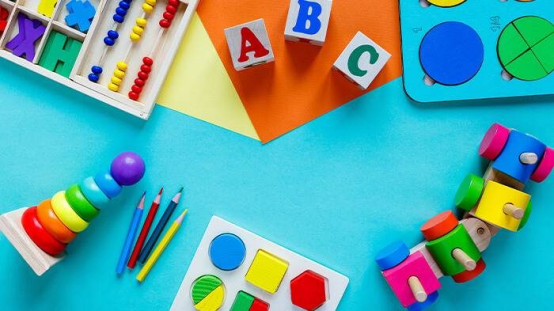
How a Dart Board Can Support Learning
Learning through play has proven to be a highly effective teaching method. It helps children learn new knowledge in a relaxed and enjoyable atmosphere, preventing boredom. Incorporating dart boards into educational tools can improve children’s math skills, as well as their concentration and hand-eye coordination. With simple adjustments, dart boards can not only stimulate children’s interest in learning but also help them develop various cognitive and motor skills.
Dart Board and Math Skills
Dartboards are a fun tool to help children improve their math skills. Through simple throwing and calculations, children can practice math operations such as addition, subtraction, multiplication, and division while enjoying the game. For example, after hitting each target, children need to perform addition or other math activities such as subtraction and multiplication according to the rules. Through this hands-on approach, children will more easily understand abstract mathematical concepts and acquire practical calculation abilities.
Example of a math game: The application of Dart Board in math learning
Children don’t need to rely on traditional math problems; they can practice math through games. For example, you can design a game where children roll specific numbers and add them together to get a total. For instance, a child might need to roll 10, 5, and 3 to arrive at the answer 10 + 5 + 3 = 18. As children master basic addition and subtraction, you can gradually increase the difficulty to challenge their mathematical abilities.
Through this interactive approach, children can understand and master mathematical knowledge while playing and gradually develop an interest in mathematics.
Improving Focus with the Dart Board
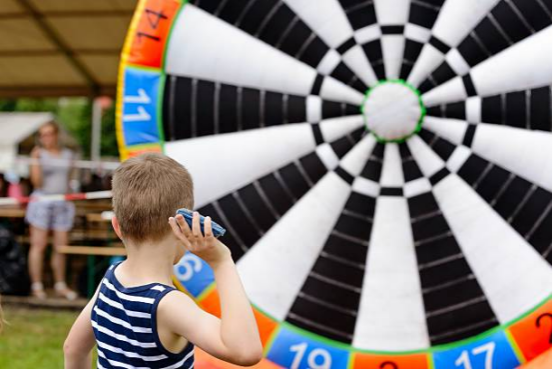
Concentration is an important skill for children’s learning. However, maintaining focus is often a challenge for many children. Using dartboards for concentration training can effectively help children improve their concentration. Accurately throwing darts requires a child’s full attention, a skill that is crucial both in the classroom and in daily life.
The Focus-Enhancing Power of the Dart Board
Throwing darts requires children to not only focus on the target but also maintain body stability and adjust the angle and force of their arms. This is a very effective exercise for improving concentration. Each time they throw, children must block out distractions, concentrate fully on the target, and maintain a calm mental state. Through repeated practice, children’s concentration will improve, which in turn will help them maintain focus in their studies.
Concentration Training Games
You can create concentration training challenges by setting time limits or requiring children to hit certain numbers consecutively. For example, you could set a task where a child needs to hit 15 points three times in a row, which not only increases the fun of the game but also enhances the child’s concentration.
Enhancing Hand-Eye Coordination Through the Dart Board
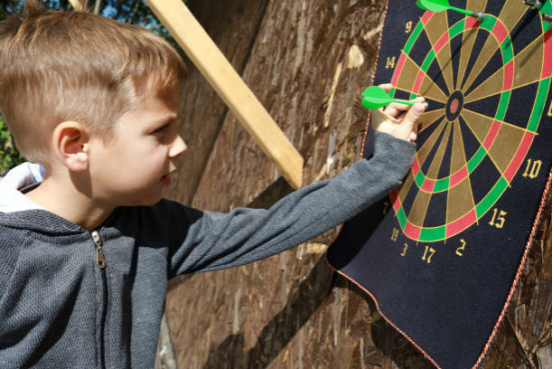
Hand-eye coordination is a crucial skill in a child’s development. Whether doing homework, participating in sports, or engaging in daily activities, good hand-eye coordination can significantly improve a child’s efficiency. A dartboard is an ideal tool for training hand-eye coordination. When throwing darts, children need to adjust their movements based on visual feedback, thus perfectly combining action and visual information.
Hand-Eye Coordination through Targeting
When playing on a dartboard, children need to judge distances, adjust their posture, and accurately aim at a target. This is not only a physical challenge but also a training exercise in visual and motor coordination. Through frequent practice, children will improve their motor skills and develop more refined motor skills. This has a positive impact on their future participation in sports and other activities that require coordination.
Hand-eye coordination training games
To further improve a child’s hand-eye coordination, you can design challenges that require them to throw darts with their non-dominant hand or set higher difficulty levels for the throw. This will not only improve the child’s concentration but also enhance their brain-body coordination.
Social Interaction and Teamwork with the Dart Board
While dart boards can be great for single-player games, they are equally suitable for group play. In team games, dart boards help children develop teamwork and social skills. During games, children not only learn how to compete with others but also how to cooperate with teammates, help each other, and increase communication and understanding.
Social and Team-Building Games with the Dart Board
In multiplayer games, dart boards can be used as tools for teamwork and competition. For example, you can set tasks that require team members to take turns throwing darts and work together to solve math problems or other concentration challenges. In this way, children naturally develop good teamwork and social skills while learning and having fun.
Fostering a Growth Mindset with the Dart Board
Most importantly, as an educational tool, dartboards can help children develop a positive mindset when facing failure and challenges. Missing the target is inevitable when throwing darts, but this doesn’t mean failure; rather, it motivates children to adjust their strategies and persevere. In this way, children can understand that failure is part of the path to success, gradually cultivating a “growth mindset.”
Resilience Through Practice
Each time they miss a target, the children have the opportunity to reflect on their actions and try to improve. Through this process of “constant adjustment and continuous trying,” the children not only learn how to improve their skills but also learn from their failures and how to cope with challenges.
Conclusion: Making Learning Fun with the Dart Board
Dartboards, as learning tools, extend far beyond the realm of games. They offer children an interactive and creative way to improve essential skills such as math, concentration, and hand-eye coordination. Whether it’s solving math problems, enhancing focus, or improving motor skills, dartboards can be a part of home education, bringing more fun and a sense of accomplishment to children. If you’re also looking for fun learning tools, consider incorporating dartboards into your child’s learning activities.
In this way, education is not just about traditional knowledge transmission but can also become an interactive, fun, and growth-oriented process. Learn more about Dart Board!