
In darts, most players rely on their dominant hand to throw, but few realize that improving left- and right-hand coordination not only balances the movement but also significantly enhances overall hand-eye control. Through systematic dual-hand training, players can achieve greater flexibility and accuracy in dart board throwing, making both competitive and recreational play more comfortable.
Analysis of the differences in movement between the left and right hands
Throwing is not a simple repetition but a chain of movements involving the shoulder, elbow, wrist, and fingers. For the dominant hand, the chain of movements often becomes a natural habit through long-term training, while for the non-dominant hand, it requires rebuilding muscle memory and coordination patterns.
Studies show that in ambidextrous darts training, the stability and speed control of shoulder, elbow, and finger movements with the non-dominant hand are generally lower than those with the dominant hand. Therefore, training should begin with breaking down basic movements, such as simulating the throwing posture, controlling the elbow angle, wrist release rhythm, and fingertip release timing. This step-by-step training not only reduces errors with the non-dominant hand but also helps players better understand the overall throwing mechanism, thus maintaining hand consistency in dart board throwing.
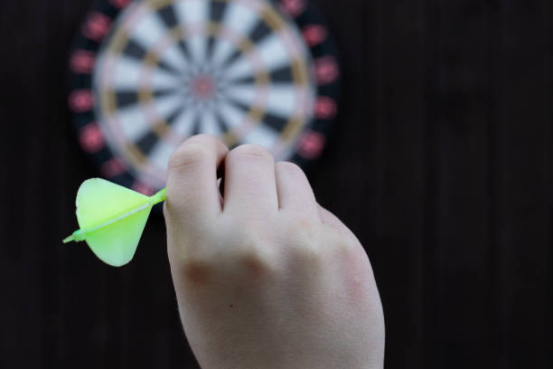
Phased training strategy
To achieve left-right hand coordination, a phased strategy can be adopted:
- Basic single-handed training
begins with short-distance throwing using the non-dominant hand, focusing on fluid movement and developing a feel for the action. This stage can be aided by marking target areas and recording the location of each successful throw, thus creating visual and muscular feedback. - Alternating between left and right hands:
Once the movement with the non-dominant hand has gradually stabilized, begin alternating between throwing with both hands. Maintain a complete motion chain with each throw, from shoulder initiation to fingertip release, ensuring a smooth dart throwing motion. This strategy enhances the coordination of the muscle groups in both hands and improves overall hand-eye coordination. - Advanced levels of fine-tuning with both hands can incorporate complex training, such as continuous throws or throws to a limited target area, forcing both hands to achieve precise control within a short timeframe. Through repeated practice, players can maintain consistency between their dominant and non-dominant hands during
dart board throws, achieving true hand dexterity.
Hand-eye coordination and precision control
The core value of left- and right-hand difference training lies in improving hand-eye coordination. By practicing with the non-dominant hand, players can enhance their perception of the dart trajectory and control of the motion chain. This training not only improves the accuracy of one-handed throwing but also helps in dealing with unexpected situations during competition, such as arm fatigue or the need to quickly switch throwing hands.
Some advanced players have shared their experience that practicing with darts of different weights or lengths in both hands allows for a more nuanced understanding of the finer points in the throwing motion. This method is particularly useful in precision release darts, ensuring that every throw accurately hits the target area.
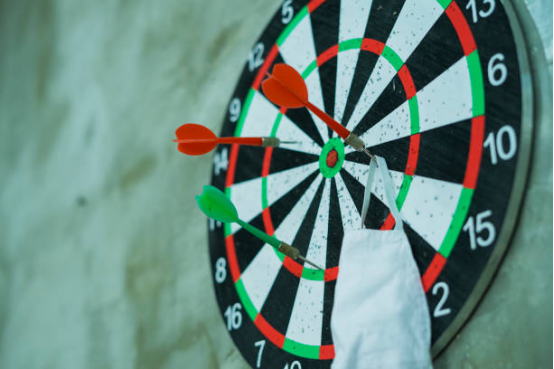
Environmental and psychological adjustment
Hand-eye coordination training involves not only improving physical movements but also psychological and environmental factors. Maintaining focus, taking adequate rest, and maintaining a proper breathing rhythm during training contribute to the stability of hand movements. By simulating competition environments, such as timed throws or setting different target areas on the dart board, players can improve their hand-eye coordination under pressure, making their left and right-hand throwing movements more natural and fluid.
In addition, familiarity with the dart board layout and scoring strategies can help make training more targeted. This ensures that left- and right-hand exercises are not just repetitive movements but a comprehensive improvement in strategy, accuracy, and performance on the dart board.
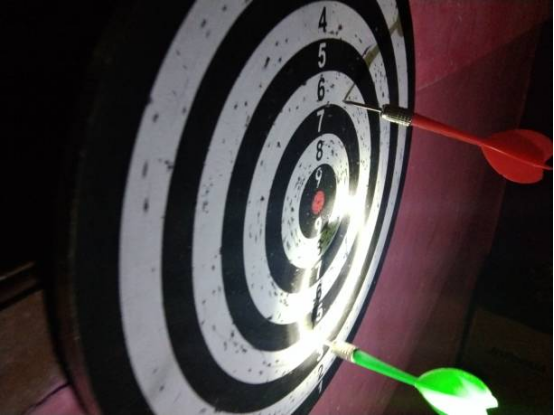
Systematic training and long-term optimization
To truly achieve hand-eye coordination, training requires a long-term, systematic approach. Players can combine movement breakdown practice, video observation, and data recording to analyze the differences between their left and right hands and make targeted improvements. For example, by comparing the hit rate, dart trajectory, and movement fluidity of their dominant and non-dominant hands, players can identify deviations in their movements and make fine adjustments. This scientific training method can significantly improve the effectiveness of dual-hand training and enhance overall throwing performance.
Ultimately, through continuous training and feedback, the movements of the left and right hands become more consistent, enabling players to achieve greater flexibility, stability, and accuracy in dart board throwing, allowing them to perform at their best in both casual play and formal competition.
Summarize
Ambidextrous darts training is a crucial way to improve dart board throwing ability. Through phased training, breaking down the motion chain, strengthening hand-eye coordination, and adjusting the psychological environment, players can achieve high accuracy and dexterity in two-handed throwing. Whether you are a beginner or an experienced player, systematic ambidextrous darts training can bring significant improvement, making each throw more confident and accurate.
Explore more practical practice methods and motion optimization strategies, and get comprehensive guidance and professional advice to make every dart board throw closer to perfection.