
unpredictable, and many training problems don’t start with “obvious mistakes.”
They’re more like a slow deviation—almost imperceptible at first, until one day you realize the same movements are becoming increasingly unpredictable; the same target is starting to “reject” you.
dart board In numerous player discussions, one detail has repeatedly surfaced but has long been overlooked:
whether the dart board has been rotated correctly and regularly.
task or Rotating the target surface might sound like a trivial maintenance task or even a bit “amateurish.” But for trainees in the medium to long term, it directly relates to the fairness of feedback, the accuracy of judgment, and whether you are being subtly misled by the target surface.
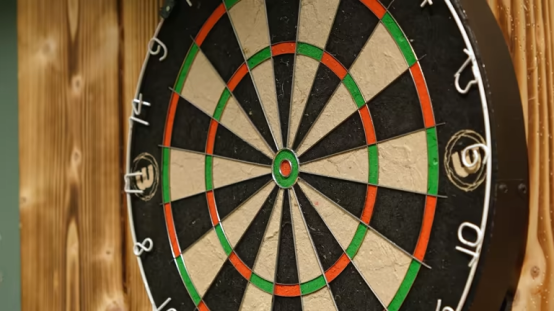
consumed. “The target surface is never ‘average consumed.'”
“blackened,” If you take a picture of the dart board after a complete training session and then compare it over several weeks, you will see a very intuitive picture:
The hit areas are highly concentrated; some areas are obviously “blackened,” while other areas remain almost unchanged.
This is not surprising.
The essence of human training is repetition, and repetition inevitably leads to localized high-frequency impacts.
For the problem is that many users assume the target surface will age “naturally and evenly.” The reality is quite the opposite. Research
on dart boards,wear balance and user feedback have repeatedly confirmed a consensus:
For a non-rotating target surface, wear always accumulates in one direction.
This will have several hidden but serious consequences:
- Changes in the rebound characteristics of the high-frequency hit zone
- The depth of “dart-eating” is inconsistent in the same area
- Edge metal structures are more prone to deformation
- The sound and touch of the hit are out of sync
Dart board but when these changes occur, players often don’t immediately suspect Dart board but rather themselves.
Without rotation, the first thing to be compromised is the judgment function, not the target lifespan.
rotation, Many people talk about rotation, only focusing on “extending its lifespan.”
But for trainers, the more crucial thing is to determine whether the system is contaminated.
smooth.” Imagine a common scenario:
You’ve been training specifically on a particular area for several weeks, and your accuracy is steadily improving. Suddenly one day, the same shots start to bounce off abnormally, or the shots are slightly off target, but the feedback is “unusually smooth.”
“disintegrated.” If the target surface has never been rotated, then you are likely facing an area that has already been “softened” or “disintegrated.”
dart board feedback. What happened at this point was not a technological regression but a structural change in dart board feedback.
You’ll The danger lies in this:
You’ll start adjusting your movements, aiming, and even your mental expectations based on incorrect feedback.
Over time, the errors become internalized, and the technology is forced to adapt to the equipment’s flaws.
This is precisely the “hidden misjudgment” that many advanced players only realize when reviewing their gameplay.

dart board Rotate the dart board correctly; this doesn’t mean just turning it one full turn randomly.
When it comes to spinning, many people ask:
“Can’t I just spin it occasionally?”
In fact, rotating the dart board correctly is not a random behavior but a logical strategy.
From extensive player practice and coaching advice, several principles that have been repeatedly validated can be summarized:
- Fixed-angle rotation: This is commonly done in increments of 90° or 180°, rather than at random angles.
- Based on usage, not time: High-frequency trainers should rotate more frequently.
- Record rotating nodes to prevent certain partitions from being ignored for a long time.
- Simultaneously check the mounting angle: while rotating, calibrate the level and height.
The purpose of rotating is not for “novelty,” but to distribute wear evenly across the entire board surface, thereby maintaining consistent feedback.
Some players even mark the number of rotations in their training logs as part of the environment variables. This practice is not uncommon in high-level training.
When to rotate is more important than whether to rotate at all.
One frequently asked question is
How often should it be rotated to be considered reasonable?
There is no single answer, but we can deduce it from the usage patterns.
In community experience and training recommendations, common indicators include:
- Some areas are becoming noticeably quieter or more stuffy.
- Differences in penetration depth occurred under the same force.
- Metal partitions in the high-frequency region are more prone to popping.
- A sudden non-technical shift occurred in the hit distribution.
Once these signs appear, rotation is often not a “preventive measure” but a “corrective action.”

The consequences of not rotating often manifest themselves in the later stages.
In the short term, there is almost no noticeable penalty for not rotating.
The target surface is still usable, hits are still counted, and training can proceed as usual.
The problem is that this “still usable” situation is quietly accumulating technological debt.
Later in the game, players may encounter:
- Unexplained fluctuations in hit rate
- The effects of technical adjustments are unstable.
- The feedback varied greatly between different training days.
- Having unnecessary doubts about one’s own condition
When these problems accumulate, checking the dart board status again often means that the best window for correction has already passed.
FAQ: Some of the most frequently asked questions about Dart board rotation
Q1: Does the electronic target also need to be rotated?
Yes. Although the principles are different, the sensing area will also experience response deviations due to long-term high-frequency use.
Q2: Are the competition targets also rotated periodically?
Yes. In a production environment, rotation and inspection are part of the standard maintenance process.
Q3: Will rotation affect the continuity of existing training data?
There will be an adaptation period in the short term, but in the long run, it can improve the reliability of the data.
Q4: Is there a problem of “over-rotation”?
Rotating every time you train might actually introduce new variables. The key is the pattern, not the frequency itself.
Training is only meaningful if the target surface is fair.
Many training problems that seem to be “human” issues ultimately point to the “environment.”
Dart board rotation is one of the most easily overlooked yet most cost-effective environmental calibration methods.
When the target surface no longer favors a certain area or amplifies a certain error, the feedback you receive truly belongs to your technique itself.
Perhaps the next time your performance fluctuates, you should pause.
Do not immediately change your technique
, but look up and see—
When was the last time your target was treated with care?