
When reviewing training sessions, many players’ first reaction is often to look at the hit rate:
50%, 60%, or even higher. The numbers are clear, the conclusion is direct, and it seems very convincing.
However, those who truly dedicate themselves to long-term dart training often realize at some point an uncomfortable truth:
Accuracy does not equal skill level.
What truly exposes the problem isn’t “how many hits,” but “how they were hit.”
When you stand in front of the dart board, the dense markings on the target surface already constitute a language—it describes your stability, control, compensatory habits, and even your mental state. It’s just that most people have never truly understood it.
The hit points are not random noise but a decodeable distribution structure.
If you take a picture of the dart board after a complete training session and zoom in to look at it from a distance, you’ll notice an interesting phenomenon:
Even players of similar skill levels will have almost identical hit distributions.
This is precisely where the value of Dart hit pattern analysis lies.
From a statistical perspective, given a sufficient number of throws, the hits cease to be random events and gradually exhibit a stable distribution pattern. Common patterns include:
- Highly concentrated but overall off-center
- It has a large coverage area but insufficient density in the center.
- One quadrant shows significant “heating,” while the remaining areas are sparse.
- The hit area is an elongated ellipse, not a circle.
These forms are not simple labels for good or bad technology, but rather external manifestations of different technological characteristics.
In other words, Dart board is not “judging” you; it is simply recording things as they are.
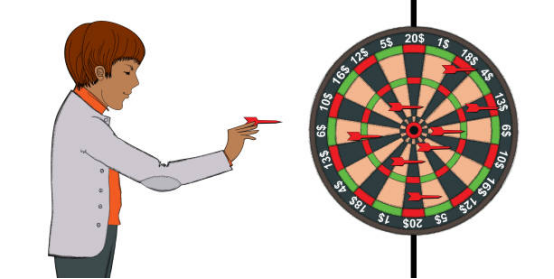
Concentration does not equal accuracy; deviation is often more alarming than dispersion.
Many intermediate players fall into a common misconception:
that as long as the hits are concentrated enough, it means the skill is stable.
However, in the analysis of Dart accuracy distribution, concentration must be considered in conjunction with “central location” to be meaningful.
Here’s a common scenario:
The hit points are highly concentrated, but the overall direction is biased towards the lower left of the target.
What does this usually mean?
- The striking motion is consistent
- However, there is a systematic bias in aiming calibration.
- Or there may be a fixed angle error at the moment of release.
This situation is more dangerous than “flying around randomly.”
because it creates the illusion of “great control,” making players prone to reinforcing the wrong pattern.
In contrast, heat maps that are slightly more dispersed but closer to the target at the center have greater growth potential. This is because dispersion means that variables are not yet locked in, allowing for greater room for adjustment.
From this perspective, the traces on the dart board are actually more honest than the real-time results.

The shape of your hits is revealing the secrets of your movements.
If you have ever carefully observed the target surface after high-frequency training, you will find that the hit points are not always “circularly distributed.”
Many players’ hit zones show a clear directionality:
- Lateral stretching
- Longitudinal stretching
- oblique strip
These shapes often directly correspond to problems related to action structure.
For example:
- An increased lateral distribution is often associated with unstable shot paths or excessive shoulder involvement.
- Longitudinal elongation may indicate insufficient control over release height.
- A diagonal shift is often related to the timing of wrist rotation.
This information will not be revealed in a single throw; it will only gradually emerge after the dart board has accumulated enough “trace language.”
This is why some coaches prefer to look at the target surface first rather than the movement when observing trainees.
Stability is not about being error-free, but about whether errors are predictable.
In advanced training, the word “stability” is often misused.
True stability is not about every dart being perfect, but rather whether the error follows a pattern.
If the offset direction is random and the magnitude is uncertain, it indicates that the control system is still malfunctioning.
If the offset direction is consistent and the magnitude is similar, then the problem is easier to break down.
This is precisely the core value of Dart board feedback.
The target surface doesn’t tell you “where you went wrong,” but it keeps repeating the same result.
And repetition itself is a clue.
Many advanced players, when reviewing their training logs, use hit distribution as a long-term indicator rather than focusing on individual performance. This approach often helps them identify the root cause of skill stagnation earlier.

When environmental factors are ignored, the hit distribution can be misinterpreted.
It is important to emphasize that the hit distribution on a Dart board does not only reflect the “human” aspect.
If there are variables in the training environment, the target feedback on the Dart board may also be distorted.
For example:
- Uneven lighting causes visual calibration shift when aiming at the Dart board
- Abnormal rebound caused by localized wear on the Dart board surface
- Slight deviation in hanging angle of the Dart board leads to magnified error over time
In these situations, players may mistakenly attribute equipment or environmental issues to their own technical shortcomings rather than factors related to the Dart board itself.
This is why, when analyzing Dart board hit distribution, more and more trainers are first confirming environmental consistency before interpreting technical issues.
FAQ: Some of the most frequently asked questions by players regarding hit distribution
Q1: How many throws need to be recorded for the hit distribution to be meaningful?
It is generally believed that at least 150-300 darts are needed for the distribution to gradually stabilize in a single target area.
Q2: If the hit points are concentrated but off-center, should I change the action first or the aim first?
Usually, calibrate the aim first, then evaluate the action. Otherwise, it’s easy to correct the action based on an incorrect baseline.
Q3: Is it necessary for beginners to analyze dart board hit distribution?
It has limited significance at the beginner stage, but establishing the habit of observation is very helpful later.
Q4: Can skill level be judged solely based on the target surface?
No. The target surface provides clues to the outcome; a comprehensive judgment still needs to be made in conjunction with movement, rhythm, and psychological factors.
The target surface doesn’t speak, but it never lies.
When the throwing is over and the training lights are off, the marks left on
The dart boards are not just random remnants. They are a long-term record, a presentation of facts devoid of emotion and self-evaluation.
True skill improvement often begins with a quiet observation:
instead of asking, “Did I shoot well today?” ask—
What are these hits repeatedly telling me?
Next time I stand in front of the target, maybe I can take my time reeling in the darts.
I should observe the distribution first, then talk about my feel for it.