The unique value of a dartboard for “low-stress exercise” for adults

exercise butAs adults, many people don’t truly give up exercise, but rather gradually distance themselves from physical activities that require “serious attention.”
Fitness, group training, and even structured home workouts all essentially require people to switch gears, invest emotionally, and take psychological responsibility for the results.
The problem isn’t whether the body can handle it, but rather that adults are increasingly finding it difficult to accept a process of constant evaluation, comparison, and reminders.
dartboard’sAgainst this psychological backdrop, the Dart Board‘s existence appears remarkably understated, yet it has been repeatedly preserved—it doesn’t emphasize training goals like gym equipment, nor does it create excitement like entertainment games, but rather provides mild physical engagement and immediate feedback in an almost “invisible” way.
This article does not discuss skill improvement, nor does it view the dartboard as a training tool. Instead, it takes the realities of adults and re-examines its unique value as a low-stress form of exercise.

What adults resist is not exercise itself, but the feeling of being forced into a state of readiness.
From a behavioral research perspective, adults’ aversion to exercise rarely stems from a dislike of physical activity but rather from aversion to the “cost of switching states.”
Consider these examples:
- Gyms require you to change your attire, plan your time, and accept the gaze of others.
- Group sports often assume that social participation is an integral part;
- Even solo training is often accompanied by progress tracking, recording, and self-monitoring.
These mechanisms are not flawed in design, but they are highly intrusive, explicitly occupying attention and constantly reminding participants that “you are doing something that needs to be done.”
What sets the Dart Board apart is that it requires almost no mental shift.
It avoids common barriers by:
- Not requiring a warm-up,
- Not implying a specific amount of time commitment,
- And not holding users accountable for their performance.
Standing there, raising your hand, and throwing—the actions themselves are so natural that the brain doesn’t perceive them as a task requiring preparation.
Because of their low intrusiveness, dartboards often do not trigger adults’ defensiveness but are naturally accepted in a way that is closer to everyday behavior.
The core of low-stress exercise lies not in intensity but in the feedback method.
The reason many forms of exercise fail is not a lack of feedback, but rather that the feedback is too explicit, even judgmental.
Digital records, leaderboards, and completion rate prompts subconsciously link exercise results with personal value, and over time, this binding weakens the willingness to participate.

Dart Board’s feedback mechanism is unusually restrained.
Whether a dart hits the target is immediately apparent; if it misses, it simply lands in another area of the board and is not marked as a failure by the system, nor is it forced to undergo a replay.
This immediate feedback is objectively real, yet it is not amplified into an emotional stimulus.
It allows users to perceive the result but does not require them to explain it.
In many user discussions about low-stress indoor games for adults, a similar viewpoint is often seen: what truly relaxes you isn’t scoring points, but the rhythm of the throwing motion itself.
This repetitive and stable rhythm is enough to allow you to briefly escape from the pressures of work or life.
It doesn’t rely on social interaction, but it also doesn’t amplify feelings of loneliness.
Adults’ attitudes toward social interaction are often not simply a matter of “like” or “dislike,” but rather a high degree of sensitivity to the intensity of social interaction.
Team sports require continuous interaction, while solo training can easily amplify self-focus, and the dartboard happens to fall somewhere in between.
It can operate entirely independently or in the presence of others, without requiring continuous dialogue or collaboration.
Even when someone is observing, attention is focused more on the actions and the board than on the interaction between people.
This structure makes darts for relaxation a realistic and feasible option.
It neither forces you into a social mode nor makes the space feel too closed off, thus providing adults with a form of activity with very low psychological burden.
The minimal physical involvement perfectly meets the practical needs of adults.
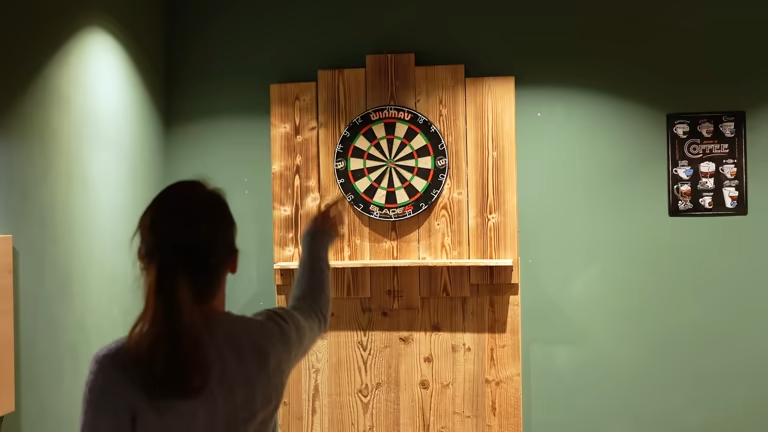
From both a physiological and psychological perspective, not all relaxation requires high-intensity exercise.
Research and user feedback indicate that low- to moderate-intensity, repetitive movements are more likely to help adults restore attention and emotional stability without causing fatigue.
complex butThe physical movements involved in Dart Board are not complex, but highly focused.
These subtle movements naturally attract sensory attention, allowing the mind to temporarily escape from daily affairs:
- The release of the wrist,
- The control of the arm,
- And the adjustment of the posture.
Many users don’t deliberately set goals but gradually feel their breathing slow down and their bodies relax after a few minutes of throwing.
This state doesn’t depend on skill improvement or require continuous pursuit of progress, so it’s unlikely to become a new psychological burden.
Why does it rarely become something that “requires persistence”?
Many lighthearted activities eventually lose their appeal because people feel they “should take them more seriously.”
Examples like fitness plans, meditation apps, and even certain hobbies can unknowingly transform into to-do lists.
The structure of Dart Board rarely induces this kind of transformation.
It avoids common pitfalls by:
- Having no hierarchical system,
- Not emphasizing a growth path,
- And instead of allowing users to participate at any frequency and in any way.
When an activity doesn’t require consistent adherence, it’s more likely to endure.
If you’re interested in how to further reduce resistance to use through space and circulation, you can refer to analyses of home darts environments, which typically explain the formation of this relaxing experience from the perspectives of accessibility and psychological comfort.
An overlooked trend in adult behavior
In the realm of home entertainment and wellness, a growing trend is that adults are actively avoiding high-commitment, high-stress activities.
stability.Rather than pursuing significant change, they prefer maintaining stability;
Ratherrather than emphasizing results, they prioritize preserving psychological leeway.
solution butFrom this perspective, the Dart Board is not a traditional exercise solution, but rather a behavioral vehicle that aligns with the psychological rhythms of adults.
change butIt does not demand change, but simply provides a buffer space that can be entered at any time.
Perhaps relaxation doesn’t need to be designed to be too “serious.”
People are more drawn to an activity that doesn’t rush to prove its value or produce results.
For many adults who don’t want to exercise or socialize, the significance of Dart Board lies in this restrained and stable way of being.
It doesn’t promise change, but it allows for relaxation.
Perhaps this is exactly the kind of low-stress exercise that adults really need.