
Table of Contents
Most family games aren’t explicitly “abandoned,” but rather gradually fade from daily life through repeated postponements.
It’s not that they’re not fun or worthwhile, but rather that each time they begin, they require more mental preparation than expected.
It is against this backdrop that Dart Board appears somewhat unusual.
It is often quietly fixed in a corner of the home, requiring no updates, no appointments, and never proactively reminding you “it’s time to start,” yet it is used continuously for a long time.
This usage is not intensive, but stable; unassuming, but enduring.
If you re-examine family entertainment from the perspective of “habit formation,” you will find that the value of the Dart Board does not come from the intensity of stimulation but from a very rare structural advantage.
The essence of start-up costs lies not in complexity but in psychological expectations.
In the home setting, start-up costs are often misunderstood as the price or number of devices, but what truly affects the frequency of behavior is people’s expectation of the effort required for a single action.
The problems with board games rarely lie in the rules themselves, but rather in what precedes them. You need to:
- clear the table.
- confirm the number of participants;
- recall the details of the game;
- assume before you start that it’s a time that “requires your full commitment.”
Even if a board game is inherently fun and easy, it still demands a clear mental shift.
The same applies to console games. Even if you only plan to play for ten minutes, the process of booting up, logging in, and getting into the game adds weight to the action. This is why many people only consider starting a game when they have relatively ample time.
The situation is even more direct with fitness equipment. Changing clothes, warming up, and setting goals are all hurdles in themselves, and these hurdles are easily postponed indefinitely in a busy daily life.
In contrast, Dart Board has virtually no such psychological burden of anticipation.
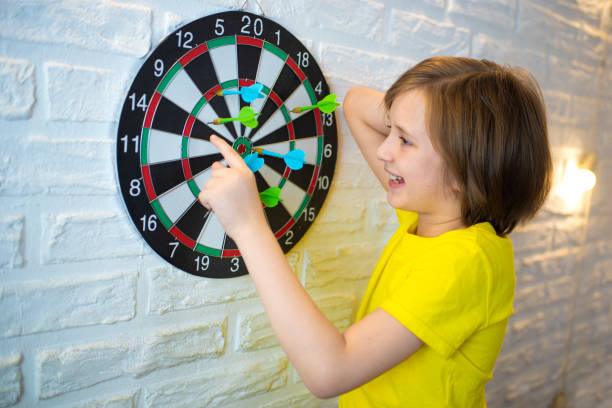
It doesn’t require you to “get into the zone,” nor does it imply that you must complete some kind of full process. You simply stand there, pick up a dart, and make a throw.
The action itself is simple enough that it doesn’t register with the brain as an activity requiring deliberate attention.
For this reason, dart board habit forming is not the result of deliberate design but rather a product of the natural orientation of the structure.
Time flexibility determines whether a behavior can be repeatedly embedded in life.
In real life, most available time is not continuous but consists of many fragmented moments.
However, many forms of family entertainment use the “whole time model” by default:
- Board games require at least a stable break; otherwise, it’s difficult to get started.
- console games often ruin the experience if you quit halfway through;
- and fitness training can even lead to frustration if it’s frequently interrupted.
The time structure of Dart Board is completely different.
It doesn’t rely on a full-time period, nor does it penalize interruptions.
You can throw just three darts, or you can end it temporarily; you can play continuously, or you can leave at any time.
This extremely high time flexibility makes it very easy to embed into daily rhythms without needing to set aside separate space for it.
Many users don’t intentionally “schedule practice time,” but rather develop daily darts practice naturally in the gaps of their lives.
The key to this behavior pattern is not discipline, but that it doesn’t conflict with the rhythm of life.
An activity is more likely to be retained if you don’t need to reschedule it.
The warmth of feedback for failure is often more important than the reward for success.
In long-term behavior, the design of failure feedback is often more decisive than success incentives.
- Failures on gym equipment are usually quantifiable: not completing the weight or not doing enough repetitions, which are easily interpreted as “not trying hard enough.”
- failures in board games are often public and amplified in social settings;
- Failures in console games are constantly reinforced through clear win-lose mechanisms.
These feedbacks are not wrong, but they all have one thing in common—they easily accumulate psychological burden.
Dart Board’s feedback on failures is unusually restrained.
If the dart misses its target and the score is unsatisfactory, this result isn’t amplified by the system, nor is it forcibly analyzed.
The board simply exists quietly, allowing you to immediately try again.
This feedback is immediate, yet not oppressive.
It makes people aware of the bias but doesn’t force them to overinterpret the results.
It is in this environment that users are more likely to remain patient and more willing to continue participating.
In the long run, this low-pressure feedback mechanism is one of the key reasons why Dart Board can be used repeatedly.
Structural differences only become truly apparent when a comparison is made.
If we observe several common family activities under the same dimension, we will find that the difference is not in whether they are “fun” or not, but whether they are suitable for frequent and low-burden repetition.
- Board games emphasize interaction but rely on social conditions;
- console games emphasize immersion but require state switching;
- fitness equipment emphasizes goals but has a high cost of failure;
- while Dart Board provides a behavioral space that can be entered and exited at any time.
This structure does not attempt to replace other forms of entertainment, but it is remarkably stable in terms of “sustainability.”
Why is it rarely “boring”?
The lifespan of many entertainment products depends on content updates and escalating stimulation.
Once the novelty wears off, usage frequency drops rapidly.
Dart Board almost completely bypasses this logic.
It doesn’t provide a storyline or create phased goals; instead, it returns the source of change to the user. Subtle changes in positioning, rhythm, and feel create a constant sense of novelty.
This characteristic makes it closer to a skill-based behavior than content consumption.
As users shift from “playing around” to “practicing casually,” the nature of the behavior changes accordingly.
Daily darts practice is often not something deliberately created, but rather something that takes shape naturally through repeated exposure.

A contrasting reality from an industry perspective
In the field of home entertainment and training products, a reality that is not often discussed is that
Most products are not designed with long-term use as the core indicator.
Complex features and rapid iterations are more likely to attract attention in the short term, but they may not necessarily contribute to sustained behavior.
Dart Board’s “restraint” in its structure, on the contrary, gives it a time advantage.
From a business perspective, it appears simple;
From a user’s perspective, this simplicity precisely signifies sustainability.
Perhaps the problem lies not in persistence, but in structure.
When an activity is lightweight, tolerant, and non-judgmental enough, it often doesn’t need to be “persisted in.”
It simply exists, and people are willing to return to it time and time again.
The Dart Board isn’t the only answer, but it offers a behavioral model worth reinterpreting.
In an increasingly fragmented life, this model may be more important than the stimulus itself.
This is precisely why Dart Board can quietly accompany people for a longer period of time among many family games.