
The living room suddenly fell silent.
The dart sliced through the air, gently striking the target with a soft “thud.”
Some people instinctively looked up, others leaned forward slightly, their eyes following the trajectory of the dart in that instant.
This seemingly ordinary little action is actually quite significant for many elderly people.
Dart boards are often underestimated as reaction time slows and hand dexterity diminishes. Unlike gym equipment that brings the pressure of “training” or complex board games that require intense thinking, dart boards subtly bring reaction time, coordination, and focus back to a more balanced level.
This article attempts to explore the positive impact of dart boards on reaction speed, hand-eye coordination, and brain activity in older adults from a more relatable perspective. It also analyzes which type of dart board is more suitable for seniors by combining real-world user experience with industry observations.

“hands.”When reaction speed slows down, the problem isn’t just with the “hands”.
problem butMany studies on reaction speed in the elderly mention a phenomenon:
Slower reaction is not entirely a muscle problem, but rather a result of a longer “perception-judgment-action” pathway.
Common changes in the daily lives of older adults include:
- The visual capture speed decreases, and the judgment of moving targets is delayed.
- Decreased fine motor control in the hands makes it easy to release the ball too early or too late.
- The brain’s ability to process multiple pieces of information declines, making it easier to get distracted.
coordination.”This is why some simple strength training methods have very limited effect on improving reaction speed.
Reaction, in essence, is a kind of “instantaneous coordination”.
dart boardThe dart board lands right at this intersection.
TheWhen a dart is picked up, the eyes need to quickly locate the target area;
the brain instantly makes judgments on distance, angle, and force.
the arm then makes a continuous but not complicated movement.
The entire process is short, clear, and can be repeated.
For older adults, this low-barrier, high-frequency stimulation is easier to maintain than “intensity training.”
How Dart board can simultaneously activate hand-eye coordination and brain activity
game.”It would be too simplistic to think of Dart board as just a “throwing game”.
,Based on practical experience with dart therapy for aging , it is more like a “lightweight neurotraining” approach.
Instant feedback mechanism for hand-eye coordination
Unlike many activities with delayed feedback, Dart board provides results that are almost immediately visible.
- Does Dart hit?
- Left or right?
- Is the force too great or too little?
This instant feedback allows the brain to quickly correct the next action.
With long-term use, many seniors find that their hand stability improves without them even realizing it.
Some users have reported that:
At first, Dart often missed the target, but after a few weeks, his shots became more “stable,” and he became more adept at everyday tasks like holding a cup and buttoning a shirt.
This transfer effect is precisely where the value of coordinated training lies.
The “passive improvement” in reaction speed
Dart boards don’t require a fast pace.
But when objectives are set, such as taking turns throwing or scoring, reaction speed will naturally be increased.
You are not asked to “hurry up.”
But in the process of participating, you are forced to make judgments faster.
This non-coercive stimulation is especially beneficial for the elderly.
Continuous stimulation of brain activity
Besides the movements themselves, dart board also involves:
- Numerical calculation (simple scoring)
- Rule memorization
- Sustained attention
These mild cognitive loads can help slow the decline in brain activity.
It’s no coincidence that many community centers have incorporated dartboards into their daily activities.
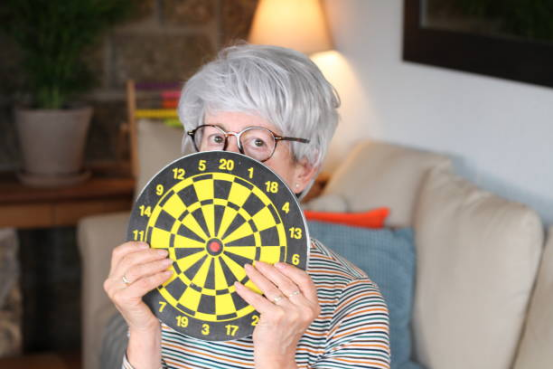
Differences in Dart Board Types and Usage Considerations for Seniors
Not all dart boards are suitable for seniors.
In discussions about dart boards for seniors, type selection is often more important than brand.
Soft target surface and sense of security
Soft boards use plastic or soft-tipped darts, resulting in less noise upon impact and a lower risk of rebound.
This is a clear advantage for older adults with weaker hand strength who require greater security.
Many users have mentioned that quiet feedback actually helps them focus better and makes them less likely to be interrupted.
Target visibility and contrast
As we age, visual contrast becomes especially important.
High-contrast color zoning and clear numerical labels can reduce eye strain.
This is why some traditional dark-colored targets are not suitable for long-term use with seniors.
Throwing distance and flexibility of posture
Standard race distances may not be suitable for home or senior settings.
Dart boards that allow for shorter distances and height adjustments are more conducive to a positive learning experience.
When “always missing the target” becomes a source of frustration, it can actually reduce the willingness to participate.
Changes in real-world usage scenarios are more convincing than data.
In many senior living communities and activity centers, dart boards are used as informal training tools.
Changes observed by staff are often more intuitive than single data points.
- Participants changed from bystanders to active participants
- The time spent hesitating before throwing was significantly shortened.
- Increased social interaction leads to more stable emotional state
One event coordinator mentioned:
Dart boards are rarely rejected because they are less like “rehabilitation training” and more like a lighthearted game.
This difference in psychological positioning directly affects the persistence rate.
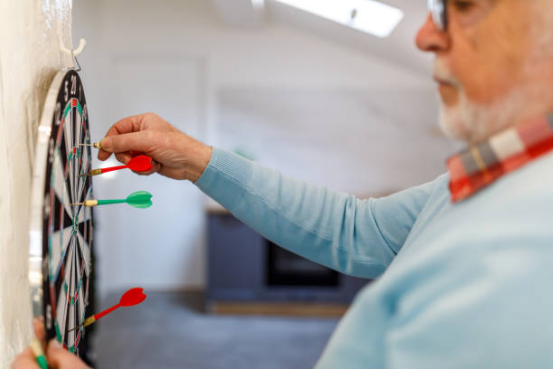
Why is the dart board often overlooked, yet deserves to be rediscovered?
When people talk about reaction training for the elderly, their first thought is complex equipment or specialized courses.
But the reality is that most people need something more:
- Easy to start
- Without relying on professional guidance
- It can be naturally integrated into daily life
Dart board perfectly meets these conditions.
It doesn’t promise immediate change.
But through repeated, low-pressure stimulation, it helps the body and brain gradually regain their coordinated rhythm.
Every throw represents a reconnection.
Perhaps what truly matters isn’t whether Dart hits the bullseye.
It’s that at that moment, the eyes, hands, and brain are once again aligned.
When reaction speed is no longer defined by “slowing down,” and
when movements become rhythmic and predictable again,
The boundaries of old age will be gently pushed open.
Next time you see a dart board,
perhaps you can look at it from a different perspective—
It’s not just a game but a gentle and continuous way of connecting.