
In many family playrooms, the dart board is always prominently displayed. When the light shines on the disc, its slightly rough, flaky texture makes you want to throw another dart. However, the longer you play, the more noticeable the subtle changes become: a certain area starts to soften, the sound of the dart hitting the ground isn’t as crisp, and even the board’s overall rebound begins to decrease.
These changes may not be immediately apparent, but with each throw, they gradually “steal” away your accuracy.
dart boardMany people’s first reaction is “replace it when it breaks,” but that’s a real shame. Most damage to dart boards is repairable, and with proper maintenance, they can even last for many years.
This article is written for those who “have played with it for a long time but are reluctant to replace it,” focusing on practical and actionable dart board damage solutions, while also incorporating real-world industry experience to provide a clear path for readers who want to delve deeper into dart board maintenance.
The real reasons for the concave surface and soft feel of the board
dart boardsMany players believe that dents in dart boards are caused by “being punctured,” but the more common explanation in the industry is
fiber fatigue.
.Most high-quality dart boards use sisal fibers, which are remarkable for their self-healing properties . After the dart tip is pulled out, the fibers spring back slightly, gradually filling the holes. However, this resilience is not unlimited; if certain areas are subjected to excessively concentrated throws, the following problems may occur:
- Regional depression
- Fiber clumping, hardening
- The surface of the board feels “loose,” “soft,” or “powdery.”
Tips.”This type of damage is most common in zones 20 and Triple 20. Many professional players have encountered the same situation, so it is even listed as the most frequent maintenance item in “Dart Board Repair Tips”.
Repair method: Rotate the plate
The most classic and effective method is rotation.
It’s very simple to do:
- freely.Loosen the number ring so that it can rotate freely;
- Adjust the worn area to a block that is not frequently hit;
- The digital ring was re-locked.
dart boardThe logic behind this method is to allow the damaged parts to “rest,” giving Sisal time to naturally rebound.
However, if your board surface already has loose particles, large holes, or large pieces of fiber falling off, then you will need more intensive dart board damage solutions.
Advanced Repair: Fiber Compression
Common methods used by industry repair technicians:
- needle.Gently loosen the hardened Sisal with a fine needle;
- Press slowly with a flat pressure plate for 10–20 seconds;
- Repeat 3–4 times.
-ringIt won’t restore the board to its original condition, but it will distribute the stress more evenly in the dented area, improving subsequent rebound.
This method is particularly effective for triple ring surfaces.
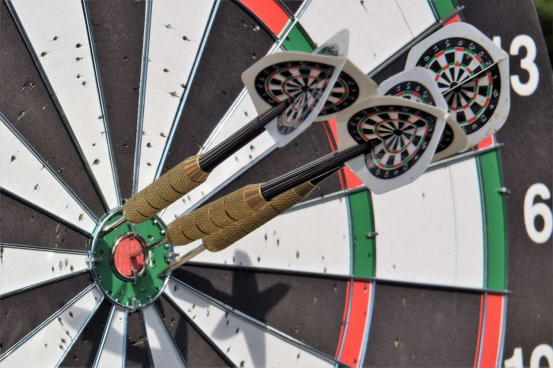
“False damage” caused by dart tip damage
dart boardMany players, seeing numerous tiny cracks on the board, assume the board is broken. However, if you frequently use darts, the problem may not be with the dart board, but rather with the dart tip.
A bluntThere is a very common misconception in the industry:
a blunt dart tip will cause more damage to the board than a sharp dart tip.
The reasons are as follows:
- A blunt dart cannot be inserted; it will scratch the surface and cause rough edges.
- vertically.This causes the fibers to be pushed laterally instead of separating vertically;
- Over time, the surface will show signs of damage, such as a “tear-like” appearance.
KeepingThis is why many dart board maintenance guides emphasize that
keeping the dart tip sharp is actually part of protecting the board surface.
Repair methods
If scratches have already appeared, you can:
- grain.Use a small toothbrush to brush away loose bristles in the direction of the grain;
- position.Gently pat the area to return the fibers to a vertical position;
- Avoid throwing in the same area for now to reduce secondary damage.
re-ground;If the dart tip is bent, curled, or has rough edges, it needs to be replaced or re-grinded; otherwise, even if you repair the board, it will be damaged again.
Industry experience data shows that steel dart tips typically need repair every 3–6 weeks.
Of course, this depends on your throwing frequency and force.
Deformation of the ring-shaped metal frame (Spider)
If you’ve ever heard that unpleasant “ding” sound when throwing, it’s likely that the spider (metal separator) has slightly lifted or shifted position.
The spider’s purpose is to divide the space, but it can also be the culprit behind dart bounces.
After the metal frame tilts up, the following will occur:
- The dart bounced back
- Causes surface fibers to crack
- The gaps widened in some areas, causing the pattern to misalign.
- dart boardLong-term damage to the edge structure of the dart board
In professional matches, such injuries can directly affect a player’s mentality and shooting percentage.
Repair methods
:Slightly bulging metal frame → Gently tap with a rubber mallet to restore flatness.
Severely displaced metal frame → The digital ring needs to be removed and the spider recalibrated.
Specific steps:
- Disassemble the number ring;
- Check if the spider is bent due to stress;
- clips.Minor damage can be gently pressed back into shape with metal clips;
- When reinstalling the digital ring, confirm that the spacing between each partition is accurate.
These types of repairs recommend gentle handling, as forceful impacts can damage the board surface and affect the fiber structure. Once permanent dents are created, they are difficult to restore.
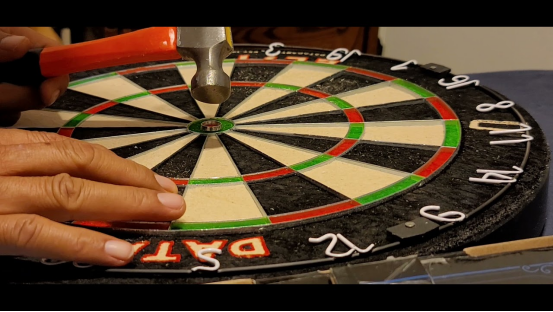
Loose frame and back panel
dart boardWhen you throw with sufficient force, a loose backplate can cause the entire dart board to wobble slightly, and this wobbling can further amplify the area of injury.
This problem typically stems from:
- Long-term influence of humidity
- The wall mounting location itself is unstable
- Loose fixing screws
- Plywood backing deformed by heat
broken;Many players have shared their experiences on industry forums:
“The board itself is not broken, it is the back plate that makes the feedback of the throw soft.”
Solution
dartboardThe most commonly used dart board damage solutions include:
- Reinforce the backplate screws
- Add shock-absorbing pads on the back
- If the wall surface is uneven, wooden strips can be used to adjust the level.
- Place a small layer of cork or EVA underneath to distribute the force more evenly.
; otherwise,It is worth noting that
Loose edges can affect the balance of the entire board, so the board must be kept level during repairs, otherwise it will affect the judgment of the throwing direction.
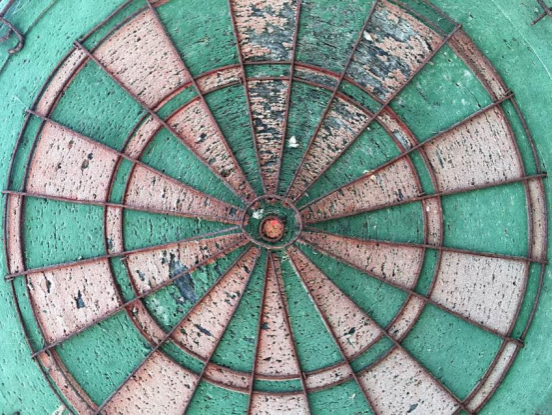
Surface aging caused by environmental factors
sisalMany enthusiasts overlook the impact of humidity and temperature on dartboards.
In fact, Sisal fibers are very sensitive to:
- Long-term dampness
- direct sunlight
- excessive dryness
Moisture → Board surface becomes soft and collapses;
Dryness → Cracks become obvious;
High temperature → Back panel deforms.
Industry experts generally recommend
an ideal ambient humidity level of 45%-60%.
Aging Repair Methods
- Mild aging: Place in a well-ventilated, cool place for 2–3 days to allow the humidity to balance naturally.
- Moderate aging: Lightly spray the outer ring (do not spray too much) to allow the fibers to regain elasticity, then let it air dry naturally.
- down butSevere aging: can only be slowed down, but cannot be restored to its original state.
Routine maintenance and long-term stability
PreventionBesides repair techniques, most dart board maintenance guides emphasize that
prevention is much easier than repair.
The following are the most common but often overlooked maintenance methods in the industry:
- Wipe the dart tip before throwing to prevent grease from remaining on the board.
- Rotation every 2–4 weeks
- Check the spider monthly for any slight lifting.
- Maintain a stable indoor relative humidity
- Cover the board with a dust cover when not in use.
- Avoid placing it near heaters or in direct sunlight.
If you consistently throw at the same area, it’s recommended to occasionally change your training routine, such as switching between different zones, to allow for more even wear on the board and a more comprehensive development of your accuracy.
dart board Your dart board can be more durable than you think.
dart boardMost players believe that a damaged dart board is simply unusable, but many symptoms can actually be prevented or repaired.
Whether it’s a dented board surface, fiber fatigue, dart tip damage, or minor spider deformation, there are solutions available.
Learn more about dart board repair tips or explore further techniques.
Sometimes, a small fix can bring your Dart experience back to its original “crisp,” “clean,” and “sound-rich” state.
And this is perhaps the most familiar and satisfying moment for every Dart enthusiast.