
In a quiet room, only the soft click of a dart striking the board can truly immerse you. But if the dart board wobbles slightly the instant you aim or vibrates gently upon impact, the sudden interruption of your rhythm makes you realize that throwing accuracy often isn’t a matter of feel but rather the variable created by the often-overlooked “stand.”
This article delves into this neglected influence, dissecting the underlying logic layer by layer, from the structure of the dart board stand to the sturdiness of the dart board mounting and how the dart accuracy stand improves stability.
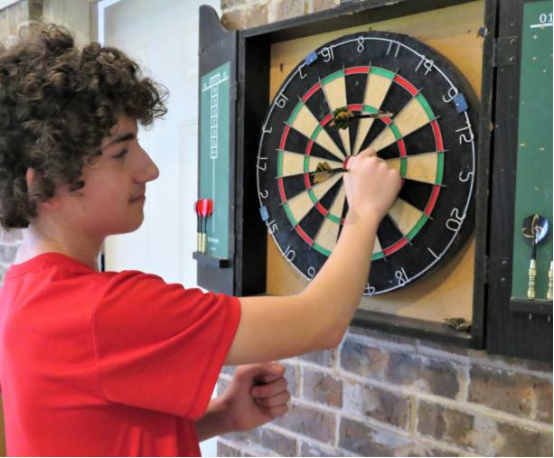
What exactly affects throwing stability?
Many people believe that inaccurate throwing is mainly due to wrist angle, foot position, or breathing rhythm. However, in in-home dart board training, a more subtle yet crucial variable is the “micro-vibration” of the board surface.
Stability is not an abstract concept but a physical phenomenon:
- When a dart hits, the resulting reaction force is transmitted back to the board surface along the support structure.
- If the support structure lacks stability, vibrations will be amplified, making consecutive throws unreliable.
One of the most frequently mentioned issues by users in forums is that “the slight wobble of the board upon impact disrupts the thrower’s rhythm.”
This wobble doesn’t even need to be visible to the naked eye; even at the millimeter level, it can shift the dart’s angle of incidence.
Therefore, the quality of your dart accuracy stand directly determines whether your home practice can simulate the stability of a real competition environment.
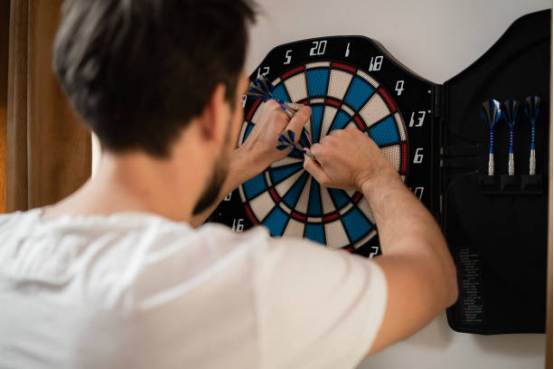
Structural differences between different dart board stands
Dart board stands, which are commonly found on the market, can be roughly divided into three categories, and their structural differences determine their support capacity and earthquake resistance.
1. Lightweight folding stand
These types of structures are typically easy to move, lightweight, and often used for temporary training spaces. For example, you can practice a couple of rounds in the living room, then move it outdoors for another couple.
The advantages are obvious—portability, quick installation, and no need to damage walls.
However, its core problem is also clear:
- The lightweight structure has a smaller contact area;
- The foot support point is relatively narrow;
- Insufficient torsional rigidity.
This causes the dart board to wobble slightly upon impact.
Therefore, this type of stand is more suitable for casual practice than for formal training that demands high stability.
II. Triangular stability stand
These types of brackets are highly regarded in the professional enthusiast community because they feature a wider base deployment angle, thereby improving overall seismic resistance.
Features include:
- The three-point support at the bottom can evenly distribute vibrations;
- The central linkage provides overall structural stability;
- Suitable for long-term, fixed-position training.
If you’re looking to improve your dart accuracy stand, this type of stand typically offers better stability than lightweight, foldable models.
III. Wall Mounting System
are Another common training method is to directly use a dart board mounting bracket to fix the dart board to the wall.
Wall mounting is not just about “hanging it up”; its adjustability, the fit between the board and the wall, and the strength of the metal bracket all directly affect the throwing experience.
Experienced players will add a shock-absorbing pad behind the bracket to prevent the shock from bouncing between walls upon impact.
This method offers extremely high stability, but its limitations are:
- Requires fixed space;
- The board surface needs to remain stationary for extended periods.
- The installation location should be carefully considered to avoid affecting the equipment’s lifespan.
If you have a fixed training room, this type of mounting performs closest to a professional stadium in terms of earthquake resistance and durability.
Why bracket stability can affect your Dart accuracy
The benefits of a stable structure are not just that it “doesn’t wobble,” but that it can form a consistent feedback system during long-term training.
1. More consistent angle of incidence
The more stable the angle at which the dart enters the board, the better you can adjust your throwing posture and understand from the feedback that the deviation comes from the action, not the equipment.
2. Reduce psychological interference
skill but Even with good technique, a slight wobbling of the dart board can create a sense of “distrust” and generate additional stress in the brain.
This stress doesn’t stem from a lack of skill, but rather from the “uncertainty” arising from the inconsistency of the equipment.
3. Not tiring even after long training sessions.
A stable stand reduces vibration transmission, making the throwing motion feel more consistent. Especially in a home dart practice space, stability makes your movements easier and your rhythm smoother during long training sessions.

dart board How to choose a reliable dart board stand
appearance butWhen choosing a stand, the key is not its appearance, but its structure.
The following aspects can help you determine whether a stand is suitable for high-stability training:
I. Bottom support area
A larger bottom geometry provides better resistance to vibrations from different directions.
This structure is particularly common in professional dart accuracy stands.
II. Torsional resistance of the uprights
If the pole wobbles slightly upon impact, it indicates a loose structure or soft material.
Higher torsional resistance means the board is less prone to lateral vibration.
III. Material of the connection location
Many users report that the most prone to loosening is the middle section of the connector.
Using a stronger metal for the connector, combined with a spiral reinforcement structure, would make a significant difference in stability.
Dart board IV. Fit of Dart Board Mounting
The better the fit between the dart and the stand or wall, the less “rebound” it will produce.
Insufficient fit will cause a slight “rebound resonance” after the dart hits, affecting the psychological state for the next throw.
Real user experience and industry trends
Based on user feedback from multiple Dart communities, player forums, and Reddit discussion boards, the most frequently mentioned tips include:
- “Lightweight frames are not suitable for high-intensity training.”
- stability but”Wall mounting offers the highest stability, but requires a fixed space.”
- “Vibration from the support frame makes target training particularly difficult.”
Meanwhile, some manufacturers have begun incorporating shock-absorbing layers into stand structures to reduce vibration transmission, a trend that has emerged in the dart board industry over the past two years.
While such structures are not mandatory, they do allow home dart practice spaces to achieve a more professional competition feel.
The dart board and stand are a complete system.
Many players consider the quality of the dart board as the sole criterion for training effectiveness, but the stand is the true infrastructure that determines stability.
A good dart board stand not only makes the board “stand still,” but it’s more like creating an invisible training system that solidifies your movements, rhythm, and habits.
When the stand cannot provide this stability, the deviations you see are not from your movements but from the equipment itself.
Therefore, a stable stand + a precise dar tboard = a complete and reliable training environment.
Conclusion
Dart board training isn’t simply about practicing techniques; it’s a process that emphasizes controlling minute variables.
When the support is stable, vibrations are controlled, and the board height is consistent, you can truly feel the improved accuracy coming from within, rather than from the randomness imposed by the equipment.
Perhaps the next time you throw a beautiful bullseye, you’ll realize stability is the foundation of accuracy.
If you’d like to further optimize your dart board setup, you can also check out our other content on throwing control techniques and training area setup; you might find key points you haven’t noticed before.
So—is your dart board stable now?