
a dart board at home HYPERLINK “https://buydartboard.com/shop/”, the correct height and throwing distance directly impact the throwing experience and safety. Many people assume that simply hanging it on the wall is sufficient. However, if the height or distance doesn’t meet the standards, the throwing experience will be affected and may even damage the wall or family members. To create a comfortable and safe throwing environment, it’s crucial to understand the standard height, throwing distance, and installation techniques for a dart board. This article will provide a detailed guide to installing a dart board at home, ensuring your dart game is both professional and enjoyable.
Understanding the standard height of dart boards
In most international competitions, the center point of the dart board (the “bull’s heart”) is 5 feet 8 inches (about 1.73 meters) from the ground, which is the standard height. This height has been proven by long-term practice to be the most suitable height for human throwing angle and visual experience.
It is also recommended to follow this standard when setting up a dart board at home. The standard height ensures that the wrist and arm are naturally extended when throwing, avoiding excessive wrist bending or shoulder tension caused by improper height.
Tips: When there are big differences in the heights of family members, you can slightly adjust the height of the center of the board, but it is best not to deviate from the standard by more than 5 cm; otherwise, it will significantly affect the throwing feel.
Throwing distance standards and adjustments
Casting distance is another key factor. For steel-tip dart boards, the official standard distance is 7 feet 9.25 inches (about 2.37 meters), measured from the leading edge of the board to the cast line (oche). Soft-tip dart boards are generally slightly more flexible, and electronic boards are generally set at 8 feet (about 2.44 meters).
In a home environment, the throwing line can be marked with tape or special markings. It should be noted that if the space at home is limited, do not hang the board too close to the wall to avoid restricting the landing point at the back and prevent the dart from damaging the wall.
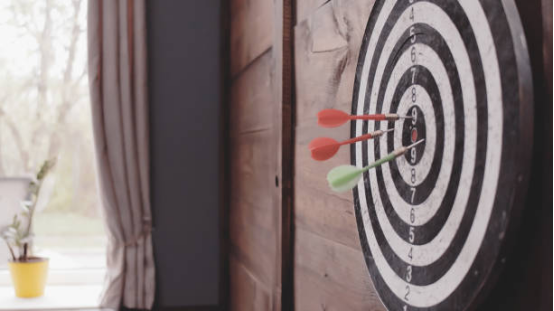
Wall protection and installation environment
Installing a dart board isn’t just about hanging the board; it also requires consideration of wall protection and spatial layout. Hard-tip dart boards, with their metal darts, can damage the wall if they miss their target. While soft-tip dart boards are safe, they can still wear down the wall over time.
Solution:
- Use a shield: Install wood, foam, or specialized wall shielding behind the dart board to absorb shock.
- Choose a suitable location: Avoid high-traffic areas or walls where furniture may collide to ensure safety.
- Good lighting: Adequate lighting helps you observe the target and improve your throwing accuracy.
Also, make sure there is enough space at the sides and back of the board to allow for extended throwing movements and to facilitate future maintenance or board replacements.
Practical tips for home installation
Measuring and marking:
First, use a tape measure to measure the standard height and throwing distance, and lightly mark the wall with a pencil to ensure that the board surface is level and the position is accurate.
Fixing method
- Hard-pointed dart board: It is recommended to use screws to ensure the stability of the board.
- Soft-tip dart board: can be used with hooks or hanging racks for easy movement and adjustment.
- Adjustable Solutions
For home environments, choose removable or height-adjustable stands to accommodate players of different heights and entertainment needs.
Safety Tips
- If you have children or pets at home, designate safe areas.
- Avoid standing on unstable ground when throwing to reduce accidental injury.
- Use brightly colored tape or the built-in markings on the electronic scoreboard to mark the throwing line, ensuring that each throwing distance is consistent, keeping the practice and game experience stable.
Common Problems and Solutions
- The board is too high or too low: This causes shoulder and wrist fatigue. Solution: Strictly measure the height of the center of the board.
- Insufficient throwing distance: Adults tend to miss the target when throwing. Solution: Make reasonable adjustments based on the standard or home space.
- Damage to walls: Darts can easily scratch walls when they miss their target. Solution: Use a protective plate or foam board to absorb the impact of the dart.
These problems show that installing a dart board at home is not just about hanging boards but also a comprehensive reflection of space planning, safety design, and user experience.
Create an ideal home dart board space
a home dart board, consider not only standard height and throwing distance, but also wall protection, spatial layout, and safety. While standard height (center of the board approximately 1.73 meters from the ground) and throwing distance (hard tip approximately 2.37 meters; soft tip allows for more flexibility) are fundamental, fine-tuning based on your home’s specific needs will ensure the best gaming experience.
A home dart board is more than just a recreational device; it’s a hub for socializing, leisure, and interaction. By balancing official standards with practical requirements during installation, you can create a safe, comfortable, and enjoyable dart environment.
How would you balance safety and standards when installing a dart board at home?