Dart Board Scorer Type Comparison: Key Accessories to Enhance Your Gaming Experience

Accurate scoring is crucial in darts, whether it’s a casual family gathering or a competitive match. While traditional manual scoring methods offer enjoyable recording, technological advancements have led to automated scoring systems becoming the preferred choice for many dart players. This article will explore different types of dart board scorers to help you choose the most suitable scoring system for enhanced accuracy and enjoyment in your darts game.
Manual vs. Automatic Scoring Systems: Choose the One That Fits Your Needs
When choosing a dart board scorer, the most basic choices are manual scoring and automatic scoring. Each scoring system has its own unique advantages and application scenarios. Below we will compare the characteristics of these two scoring systems in detail.
A. Manual Scoring System
Manual scoring is the most traditional method, typically requiring players to record their scores after each throw. For players who enjoy being hands-on and recording their gameplay, manual scoring offers a nostalgic and simple alternative. Advantages of manual scoring include:
- Lower cost: Manual scoreboards are generally cheaper than automatic scoreboards, making them suitable for players on a budget.
- Enhanced sense of interaction: When recording scores, players can focus more on the results of each throw, which increases the interactivity of the game.
- Strong durability: Without complicated batteries or electronic components, the manual scoreboard is almost indestructible.
However, manual scoring also has its drawbacks. Especially in high-intensity matches, it can be prone to inaccurate scores due to manual errors. Furthermore, continuous scoring can be tedious for some players, especially when they need to record quickly.
B. Automatic Scoring System
In contrast, automatic scoring systems use electronic technology, such as built-in sensors or cameras, to automatically calculate the score of each throw. This type of system not only reduces the burden on players but also improves the accuracy and convenience of the game. The advantages of automatic scoring systems include:
- :Accurate and accurate : The electronic system can accurately record the score of each throw, eliminating human error.
- Improve game speed: No need to manually record scores; players can focus more on throwing the ball, improving the overall game rhythm.
- Diverse functions: Many modern dart board scorers are equipped with additional features, such as statistics of historical scores, display of leaderboards, and even simulation of different dart game modes.
The downsides of the automatic scoring system are its relatively high price and certain maintenance requirements. In addition, since it relies on electricity and electronic components, it may encounter battery or hardware damage after long-term use.
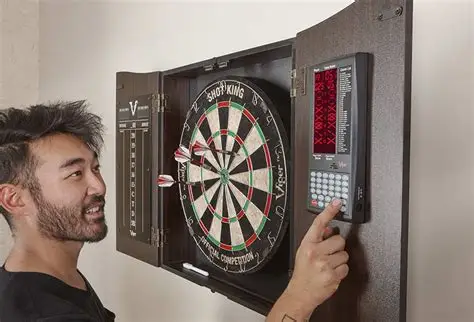
Different Types of Auto-Scorers: Functionality and Applicability
There are several types of automatic score counters, depending on how they work and what additional features they have. Understanding these different types of score counters can help players choose the most suitable product for their needs.
A. Sensor-type automatic scorer
This type of scorer uses sensors to identify the area where the dart hits and calculates the score. Most modern dart boards are equipped with this type of scorer. The advantages of a sensor-based scorer are its accuracy and responsiveness, allowing it to quickly identify the throw and update the score in real time.
- Applicability: Suitable for family entertainment and friendly competitions, it can automatically record scores and reduce players’ operation time.
- dart board andAdvantages : No additional accessories or settings are required; it is directly integrated into the dart board, easy to use.
- :Disadvantages : It may require higher quality and throwing angle of darts, and low-quality darts may affect accuracy.
B. Camera-based automatic scoring device
dart boardCamera-based scorers use a camera mounted above the dart board to track the position of the darts. Using image recognition technology, these scorers can precisely identify the impact location of the darts and automatically calculate the score. Compared to sensor-based scorers, camera-based scorers generally offer greater accuracy and more features.
- :Applicability : Suitable for competitive dart players and high-level competitions, it can provide higher accuracy and richer data analysis.
- :Advantages : It can record the trajectory and hitting position of darts, providing more comprehensive data support.
- :Disadvantages : higher price, requires stronger hardware support, and may require a larger space for installation.
C. Fully automatic system (intelligent device integration)
Fully automated systems typically combine sensor and camera technology with more advanced smart devices. These systems often have Bluetooth or Wi-Fi capabilities, allowing them to connect to mobile apps or computers to sync data in real time and even provide detailed game analysis and statistics.
- :Applicability : Suitable for technology enthusiasts and professional players, able to provide a deeper gaming experience and data feedback.
- Advantages: You can use smart applications to analyze your personal performance and even compare it with players around the world.
- Disadvantages: Higher equipment and installation costs, more complex to set up and maintain.
Choose the right scorer to improve your dart game experience
Whether you’re an amateur or a professional, choosing a dart board scorer that suits you can greatly enhance your gaming experience. Manual scoring is suitable for players who prefer interaction, while automatic scoring systems can reduce operational errors and improve gaming efficiency. Among automatic scorers, sensor-based, camera-based, and fully automatic systems each have their own advantages, depending on their functionality and price, suiting players with different needs.