
The moment of accurately hitting the bull’s eye isn’t just a release of power; it’s a moment of perfect synchronization between consciousness and breathing. Many people think Dart Board is a test of skill, but for true experts, it’s a training in “flow”—how to focus your attention on a single, unwavering line, even in a noisy environment, and aim for the bull’s eye.
In psychology, this state is called “flow,” a peak experience of total engagement. For dart players, it’s not just a technical performance but also a mental exercise.
The physics of concentration: Synchronizing muscle and mind
When a player raises a dart, their brain, eyes, arms, and heartbeat are engaged in an extremely complex coordination process. In “Flow: The Psychology of Optimal Experience,” psychologist Mihaly Csikszentmihalyi points out that when an individual enters a flow state, their sense of time blurs, distractions disappear, and their entire consciousness revolves around a single goal—in this case, the center of the dart board.
This kind of focus isn’t innate; it’s engineered. For example, professional athletes automate their movements through repetitive practice, freeing up more mental energy to maintain focus. Research shows that precision throwing is based on a perfect match between muscle memory and mental rhythm. When the body enters a routine, the brain’s need for control decreases, freeing up consciousness to focus fully on the bull’s eye.
The Dart Board’s physical structure implicitly supports this process. A high-quality board provides enhanced tactile feedback, allowing players to adjust force and angle instantly. This subtle feedback mechanism is crucial for maintaining sustained mental focus.
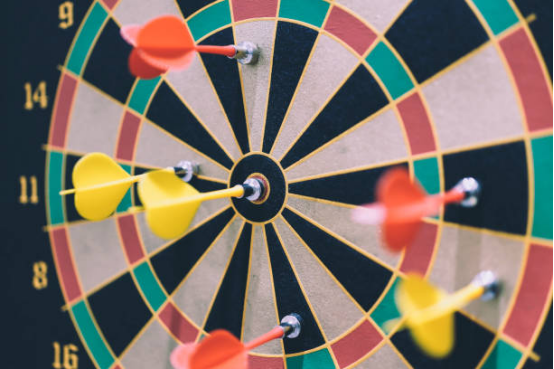
The Invisible Dimension of Mental Training: Anxiety, Patience, and Micro-Decision-Making
Interestingly, failure in darts often stems not from technical failure but from a psychological breakdown. An over-eagerness to win, a fear of losing, or a distraction from the crowd’s noise can all disrupt the original rhythm. The primary challenge a dart board practitioner faces isn’t accuracy but emotional control.
Mental focus exercises can even account for half of elite athletes’ training plans. Some sports psychologists recommend “breathing circuit training”—inhale for four beats, hold for four beats, and exhale for four beats before each throw, allowing the breath to set the rhythm of the body. This conscious rhythm can significantly reduce anxiety and increase the likelihood of entering flow.
Another strategy is “attention partitioning,” which involves dividing your attention between the bullseye, the dart, and the fine-tuning of your own posture. By training your brain to make these “switches” in an instant, players can maintain fluid decision-making during tense situations.
Research has also found that consistently using a familiar dart board can improve psychological stability. This is because the familiar feel and visual layout reduce uncertainty and help the mind regain control more quickly. This is why professional players avoid frequent changes in their dartboards—it’s not just about equipment; it’s also about providing a psychological safety zone.
From Competition to Meditation: Dart Board’s “Meditation Mechanism”
In the West, some psychologists have begun to consider darts a form of “dynamic meditation.” It might sound counterintuitive—after all, you’re holding a sharp piece of metal, not sitting cross-legged—but the core logic is the same: it trains attention to stability and focus.
The “focus window” for darts is typically only a few seconds. Those few seconds of mental stability are similar to the state of “breathing awareness” in meditation. The difference is that the Dart Board provides instant feedback—every dart you throw is a physical measurement of your focus.
Many mental coaches have begun to introduce darts training into team sports to help athletes regain their ability to control their attention. For example, the English Football Association’s mental training courses include a darts focus session to improve players’ mental stability during crucial free throws.
Even more interesting, this training has also been shown to be effective for managing everyday stress. Studies have found that just five minutes of Dart Board throwing practice during work breaks can significantly reduce cortisol levels. In other words, the process of aiming for the bull’s eye actually “recalibrates” your brain.

Double upgrade of product and mindset: the hidden value of a high-quality Dart Board
You might not realize that the results of your mental focus training are highly dependent on the equipment you use. A target with uneven rebound and a rough surface will disrupt your sense of rhythm and feedback accuracy. A high-quality Dart Board provides smooth feedback—key to maintaining flow.
New silent dartboards, carbon fiber composite structures, and self-healing hole technology are bringing darts closer to “psychological experiment-level” accuracy. In particular, the use of densely packed hemp fiber on the target surface not only prolongs its lifespan but also maintains a consistent feel, allowing players to build a continuous sense of confidence with every throw.
From a psychological perspective, this “reliability” greatly enhances concentration. When the external environment is stable and controllable, the brain is more likely to enter a highly efficient, automated focus zone. For users pursuing psychological growth, a high-quality Dart Board is not just an entertainment tool but more like a meditation device.
Business revelations of flow: from dart training to workplace efficiency
This “precision focus” approach has long been adopted in corporate training. Many Fortune 500 companies have incorporated Dart Board-based simulated focus training into their team management and performance coaching, helping employees experience the mindset of “goal focus.”
In this type of training, the bull’s-eye represents the KPI, the dart symbolizes the execution action, and the arc from hand to target represents the flow process. Through repeated throwing, people can experience the power of focus and learn how to block out noise and reestablish a rhythm of decision-making in complex tasks.
This is the deep charm of Dart Board – it makes “precision” a psychological strategy rather than a simple hand skill.
Precision is a gentle power
Focus is never about shutting yourself off from the world, but rather about achieving peace with the present moment. Dart Board teaches us not only the technique to hit the bull’s-eye, but also a philosophy of “steady mind and precise action.”
Maybe next time you throw that dart, try to slow down a bit—feel the air, hear the rhythm of your breathing. Because the real hit isn’t in the bull’s-eye, but in the flow.